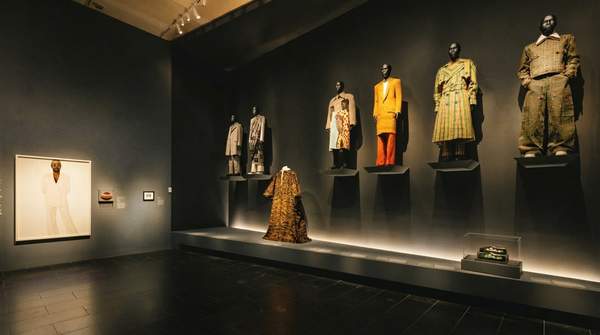
Why does one fashion presentation feel like a coherent story, another like a conversation, and a third like a deliberate act of sabotage? The answer, I'd argue, lies less in the clothes than in the curatorial model behind them. A 2025 study by Angelica Vandi and Judith Clark proposes a codification of fashion curation built on three interrelated models—Narrative (content and themes), Staging (spatial and visual storytelling), and Experience (audience interaction and mediation)—treating object selection, narrative construction, spatial arrangement, and visitor engagement as the decisions that frame cultural storytelling.
Set that framework beside two very different documents—a museum toolkit for community-based curation and a blistering critical review of a New York exhibition—and three distinct curatorial philosophies emerge. The scholar's evidence is drawn from museum exhibitions, so applying these models to ready-to-wear presentations is my analytical extension, not a claim the sources themselves make.
Introduction: The Evolving Art of Fashion Curation
Curating fashion has never been a neutral act of hanging garments on mannequins. The Vandi–Clark framework explicitly frames curatorial decisions—what gets selected, what story gets told, how space is arranged, how visitors are engaged—as mechanisms of cultural storytelling. And the study is candid about its own limits: it offers a "possible useful (non-exhaustive) codification," a deliberately provisional map rather than a finished theory. That modesty is useful, because the moment you look sideways at how other institutions curate, the map grows new territories. What happens, for instance, when the curator's primary goal is not storytelling at all, but handing authority to a community? Or when the goal is to dismantle the very system the garments belong to?
Narrative/Structural Curation: Crafting Stories Through Fashion
The first model is the most familiar—the exhibition (or presentation) as authored text. Its primary goal is to construct a coherent story or theme around fashion objects, using historical or conceptual frameworks as scaffolding. Its methods are structural: object selection, spatial arrangement, and the deliberate construction of narrative, as codified in the Narrative, Staging, and Experience triad. The audience, in this model, is primarily an interpreter—a reader, if you like, of a text the curator has written in space. There is a clear authority here, and a clear authorship, and that is precisely its power (and, as we will see, its vulnerability to critique). Thematic coherence is the measure of success; the visitor leaves having followed an argument.