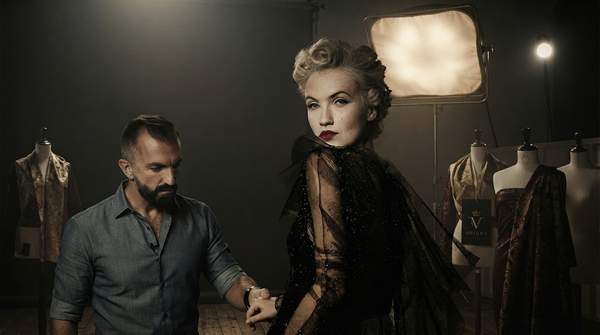
The haute couture fitting began as a pampered, in-person ritual inside the private salons of mid-19th-century Parisian fashion houses, where clients were received as guests in a couturier's well-appointed room. Today, the same made-to-measure promise is delivered through a structured, multi-stage process that can begin with a toile fitting in a Paris atelier and continue in direct dialogue with the couturier, wherever the client lives. What changed is not the craft but the relationship: the client has moved from spectator to active participant, and the process now spans physical rooms and digital channels at once.
The Intimate Origins: 19th-Century Haute Couture Salons
The salon, as Cornell University's Intypes research project traces it, takes its name from the French word for a well-appointed room in a palace or large home for receiving guests. The retail practice originated with the salons of the Parisian maisons de couture — the fashion houses — of the mid-19th century, and only later migrated outward, appearing in early 20th-century specialty shops such as the Viennese firm Kniže, designed by Adolf Loos, and eventually in department stores like Bergdorf Goodman in New York by the 1950s.
What mattered for the couture client was the atmosphere the salon created: as the Intypes study describes one such shop's clientele, customers were "ensconced in an intimate salon reserved exclusively, albeit temporarily, just for them" and "pampered from the moment they set foot in the door." The generous club chairs and the deliberate scarcity of displayed product communicated selectiveness. The fitting, in this model, was inseparable from a physical setting — a luxurious room, personal attention, and manual adjustments performed on the client's body in the couturier's presence.
The Modern Multi-Stage Process: Structure and Precision
Contemporary couture keeps the client at the center but replaces the single salon visit with a sequence of stages, each answering a different question about the garment. As the Paris house Maison Julien Fournié describes its own process, the first fitting takes place on the toile — "a founding stage of any bespoke creation." A couture piece begins with a sketch and a desire, then the taking of measurements for new clients, then the first fitting of the model made in a white canvas, as Isabelle Cerboneschi reported in her account of Fournié's fittings. Only after this prototype stage is refined does work proceed toward the final fabric.
"A fashion drawing communicates a direction, but paper does not settle how a garment will stand, fall or move on a body."
That observation from the atelier-focused publication Elyrea explains why the toile exists at all: proportions that appear convincing in an illustration must be translated into three dimensions, and the toile fitting is where that translation is tested and corrected. By contrast with the salon era, when the first encounter with the garment and its refinement happened largely in one luxurious physical setting, the modern process distributes these moments across distinct stages, each with its own purpose and its own moment of client judgment.