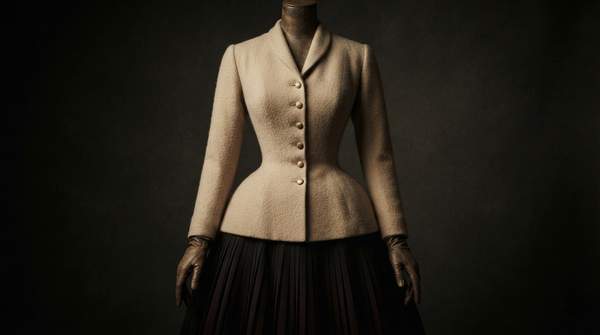
Christian Dior's "New Look," unveiled on February 12, 1947, dramatically reshaped post-World War II fashion by introducing a silhouette characterized by opulent femininity and intricate structural design. This revolutionary collection, initially known as "Corolle" and "En 8," offered a stark contrast to the utilitarian styles prevalent during wartime austerity. It quickly became a symbol of French haute couture's rebirth and set a new course for fashion, emphasizing a return to glamour and sophistication through its distinctive architectural elements and meticulous construction.
The Post-War Genesis of Dior's 'New Look'
Christian Dior's inaugural collection emerged during a period of significant societal change following World War II, a time marked by an "Arctic winter" in Paris. After years of military and civilian uniforms, coupled with sartorial restrictions and shortages, Dior offered more than just a new aesthetic; he presented a "new outlook," according to The Metropolitan Museum of Art. This curvy silhouette achieved unparalleled success, both symbolically and commercially, representing the rebirth of French couture after the German occupation and quickly gaining international acclaim across Europe and America.
The establishment of the House of Dior in 1946, backed by textile manufacturer Marcel Boussac, was part of a broader effort to reestablish Paris's couture industry as a component of France's economic and social recovery. Dior's design expertise, combined with his marketing acumen, led to a wildly successful fashion enterprise. From 1947 to 1957, the House of Dior dictated fashion across Europe and the United States, as noted by the Avenir Museum of Design and Merchandising, demonstrating the profound impact of his initial statement.
Defining the Iconic Silhouette: An Overview
The "New Look" marked a dramatic shift in women's fashion, moving away from the utilitarian styles of the war years towards a celebration of decorative femininity. Vogue's editor at the time, Edna Woolman Chase, observed in her memoir that Dior's clothes, while wearable, gave women "the feeling of being charming costumed," imbued with a romantic flavor. The silhouette was celebrated for its luxurious fabrics and elegant lines, evoking a sense of glamour and sophistication that had been absent during wartime.
Characterized by rounded shoulders, cinched waists, and full skirts, the "New Look" emphasized an hourglass figure, a deliberate departure from the angular, restricted forms of wartime fashion. This aesthetic embraced a vision of ultra-femininity and opulence, creating a distinct figure-eight silhouette. The Avenir Museum of Design and Merchandising notes that this shape was often complemented by large picture hats, which further accentuated the wide curve at the top of the figure, rounding out the overall dramatic and sometimes unexpected shapes achieved through Dior's unique combination of draping and tailoring.