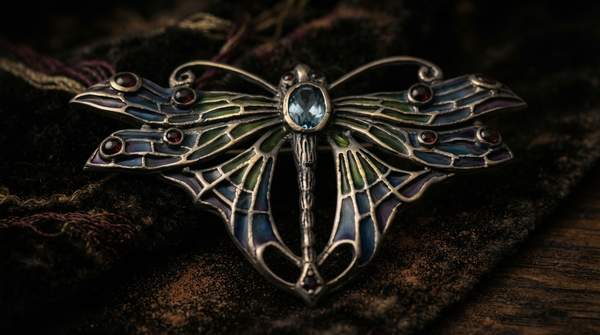
Plique-à-jour enameling is a highly specialized technique that creates a stained-glass effect by applying transparent enamel to metal cells without a backing, allowing light to pass through. Often referred to as "backless cloisonné," this method is distinguished by its luminous quality, which has captivated art collectors and luxury enthusiasts for centuries.
The technique involves fusing specially formulated glass, or enamel, to metal, typically gold or silver. This intricate process is known for its technical difficulty, high failure rates, and time-consuming nature, contributing to the rarity and value of surviving pieces. Its application has evolved significantly across different historical periods, reflecting diverse aesthetic and material uses.
Mastering the Craft: Primary Plique-à-jour Techniques
Plique-à-jour enameling demands significant patience and skill due to its complex nature and high failure rate, according to anOrdain. The process involves filling metal frameworks with transparent or translucent enamel, which is essentially glass fused to metal, as described by Plique-a-jour Enamel. There are several distinct approaches to creating plique-à-jour, each with its own set of steps and challenges.
One primary method is pierced plique-à-jour. This technique begins by cutting shapes from a metal sheet, such as silver, to form open cells. A small hole is first pierced through the metal to allow a jeweler's saw to cut around the desired design, as detailed by anOrdain. These open cells are then carefully filled with wet enamel.
Another significant technique is filigree plique-à-jour. This method involves using fine metal wires, often gold or silver, to construct the cell outlines. Benvenuto Cellini, as recounted by Linda Darty in "The Art of Enamelling," described forming gold filigree wire designs inside an iron bowl, held in place with gum tragacanth. After inlaying the enamel, the piece undergoes repeated firing at increasing temperatures until the cells are uniformly filled. Plique-a-jour Enamel further explains that filigree plique-à-jour is a building-up process where gold or silver wires are worked over a metal form and soldered together.
Some plique-à-jour techniques also incorporate the use of temporary backings during the initial stages of the process. Materials like mica or burnished copper foil can support the enamel during firing, and are subsequently removed once the enamel has set. Other methods rely solely on surface tension to hold the enamel in place without any temporary support, anOrdain notes.
Plique-à-jour Techniques: A Comparative Overview
| Technique Type | Process Description | Key Materials/Tools | Historical Examples |
|---|---|---|---|
| Plique-à-jour (General) | An enameling technique that creates a stained-glass effect by filling metal frameworks with transparent enamel without a backing, allowing light to pass through. | Transparent/translucent enamel (glass), metal (gold, silver) | Ancient Greece (2nd millennium BC), Medieval France (12th-17th centuries), Art Nouveau (1880-1914) |
| Pierced Plique-à-jour | Involves cutting out designs from a sheet of metal to create open cells, which are then filled with wet enamel. | Metal sheet (e.g., silver), jeweler's saw, enamel | Often used for intricate designs where a solid metal base is initially shaped. |
| Filigree Plique-à-jour | Uses fine metal wires to form the cell outlines, which are then fused and filled with glass enamel. | Fine metal wires (gold, silver filigree), gum tragacanth (for temporary hold), iron bowl (historically) | Benvenuto Cellini's described process; favored by Art Nouveau artists for delicate, organic forms. |
| Temporary Backing | A method where temporary backings (e.g., mica, burnished copper foil) support the enamel during firing, removed after the process is complete. | Mica, burnished copper foil, enamel, metal framework | An alternative approach to enameling without a temporary backing, used to manage the fragility of the enamel during firing. |
A Journey Through Time: Historical Evolution of Plique-à-jour
Plique-à-jour is an ancient technique, with its origins tracing back to Ancient Greece in the 2nd millennium BC, as noted by L'ÉCOLE Van Cleef & Arpels. Enameling, generally, is described as a skillful alchemy involving the fusion of metal and glass, a practice that has been continually reinvented by master glassmakers over centuries.
The art of enameling, including plique-à-jour, gained significant popularity in France between the 12th and 17th centuries. During this period, enameling techniques were passed down through prominent families of enamellers who continuously developed new methods. While champlevé enamel was particularly popular in the Middle Ages, plique-à-jour was also employed, with figures like Parisian enameller and jeweler Charles Riffault using it for Maison Boucheron in the 1870s and 1880s, according to L'ÉCOLE Van Cleef & Arpels.
The technique experienced a notable resurgence and widespread popularity during the Art Nouveau movement, which spanned from 1880 to 1914. This era saw plique-à-jour adopted by renowned artists such as René Lalique and Louis Comfort Tiffany, who incorporated it into various small ornaments and fine jewelry, anOrdain reports. The lightness and transparency of plique-à-jour were particularly suited to the Art Nouveau aesthetic, which often sought to replicate natural forms and their delicate qualities.
Evolving Aesthetics and Materials Across Eras
The aesthetic and material application of plique-à-jour enameling has evolved considerably, reflecting the artistic sensibilities of different historical periods. In its earliest mentions, such as in Ancient Greece and Medieval France, the technique was part of a broader tradition of enameling, contributing to the richness of jewelry and works of art. While specific aesthetic details from these early periods are not extensively documented in the provided passages, the general use of enamel enhanced pieces with depth and intense brilliance, as L'ÉCOLE Van Cleef & Arpels describes.
The Art Nouveau movement (1880-1914) marked a distinct period for plique-à-jour, where its unique qualities were fully embraced. Artists of this era, including René Lalique and Louis Comfort Tiffany, utilized plique-à-jour to achieve a sense of lightness and transparency, often in designs depicting natural elements like flowers, leaves, and insects, according to anOrdain. Lalique, in particular, perfected the technique, frequently pairing the transparent glass with a wider range of materials beyond traditional gold and silver, such as copper, iron, and aluminum, to achieve varied effects.
This period saw plique-à-jour's aesthetic shift towards replicating the delicate, ethereal qualities of nature, with the enamel's ability to "let in daylight" becoming a central design feature. The fine metal strands, typically gold or silver, that form the cells in plique-à-jour, similar to cloisonné, allowed for intricate and flowing designs that complemented the organic forms characteristic of Art Nouveau, anOrdain explains.
The Enduring Challenge: Rarity, Value, and Technical Mastery
Plique-à-jour enameling is widely regarded as a technical "tour de force" in the world of enameling, a testament to its inherent difficulty and the exceptional skill it demands. Both anOrdain and Plique-a-jour Enamel emphasize that it is the most technically challenging and time-consuming method, characterized by a high failure rate. This arduous process requires immense patience from those who pursue the craft.
The fragility of plique-à-jour pieces further contributes to their rarity and value. Plique-a-jour Enamel notes that these items are more delicate than other types of enamel work and necessitate careful handling. The extensive time investment and the potential for high failure rates mean that the worth of these pieces lies not merely in the intrinsic value of the metal base, but in the inspirational designs and the high quality of craftsmanship required to bring them to fruition. Surviving examples, such as a 16th-century Swiss plique-à-jour plaque depicting the Virgin and Child, underscore the historical significance and enduring value of these masterworks, as highlighted by anOrdain.
Appreciating Plique-à-jour: A Legacy of Light and Skill
Art collectors and enthusiasts should recognize plique-à-jour pieces as rare and valuable examples of exceptional craftsmanship, distinguished by their intricate, light-filled aesthetic and the mastery required to overcome significant technical challenges. The presence of transparent, backless enamel work that mimics stained glass, often in intricate metal frameworks, indicates a plique-à-jour piece.