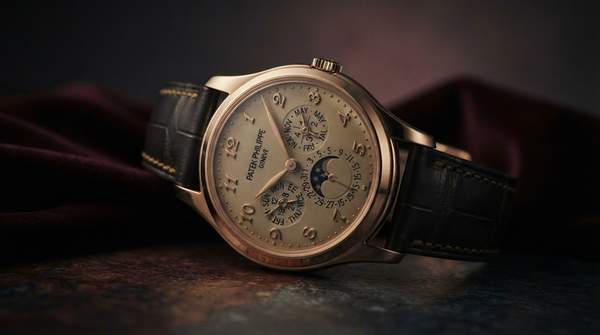
The three most coveted complications in luxury watchmaking—the perpetual calendar, the minute repeater, and the tourbillon—earn their prestige not from added practicality but from extreme mechanical complexity and the historical innovation required to build them. A "grand complication" is generally understood as a timepiece combining complications from multiple categories: timing, calendar, and astronomical functions, often containing hundreds or even thousands of parts. This guide defines each mechanism, traces its origins, and explains why collectors rank them at the summit of horology.
Understanding Watch Complications: Beyond Timekeeping
A watch complication is any function beyond the basic display of hours and minutes. That definition spans everything from a simple date window to mechanisms of extraordinary sophistication. Horological writers generally group complications into three families: timing complications such as the chronograph, split-seconds, and minute repeater; calendar complications such as the perpetual and annual calendar; and astronomical complications such as the moon phase.
While definitions vary, most experts agree that a true grande complication must include at least one complication from each of these three categories, according to Gray & Sons' guide to luxury watch complications. Such pieces represent the pinnacle of watchmaking achievement, and their prices reflect the extraordinary skill and countless hours their creation demands—with some pieces reaching into the millions of dollars. The three complications examined below are the ones most consistently cited as the elite of this elite.
The Perpetual Calendar: Mastering Time's Irregularities
The perpetual calendar complication shows the date, day, month, and year—and, crucially, it does so automatically. Its movement mechanically accounts for the varying lengths of the months and for February 29 in leap years, so the user never needs to correct the date at the end of a short month. Crown & Caliber's history of the complication notes that it takes leap years into account over the course of a century; once a century, a perpetual calendar watch requires manual adjustment to account for when the leap year is bypassed.
The complexity lies in the programming: a mechanical gear train must "know" that some months have 30 days, others 31, and that February has 28 or 29 depending on a four-year cycle. As Jewels by Love explains, this leap-year exception makes the watch far more complex than it appears, since the user does not need to correct the date to March 1 in a leap year.
Its history begins in the pocket, not on the wrist. The English watchmaker Thomas Mudge is credited with building the first perpetual calendar mechanism in a pocket watch in 1762, an invention so complex that it remained a rarity for over a century. Patek Philippe patented the perpetual calendar for wristwatches in 1889 and built the first perpetual calendar wristwatch in 1925, bringing the complication into the modern era.
The Minute Repeater: A Symphony on the Wrist
The minute repeater chimes the time on demand. When a lever is activated, the watch sounds the hours, quarters, and minutes through a sound-producing mechanism built into the movement. According to Watches of Switzerland's complications guide, the chimes are distinguished by differing sound levels, so a listener can tell hours from quarters from minutes without looking at the dial.
What makes the minute repeater remarkable is not the function itself but the mechanism behind it. It is noted as one of the most complex mechanisms in watchmaking, requiring tiny hammers and gongs to strike the correct sequence of tones for any given time—accurately, and on demand. This is sound engineering in the most literal sense, executed at the scale of millimeters.
It is also a genuinely vintage complication. Hing Wa Lee Jewelers describes it as a tool used primarily in centuries past, rarely used for practical purposes today. Before electric lighting and luminous dials, a repeater let its owner tell the time in the dark; today it is valued for its historical ingenuity and the acoustic beauty of its chimes rather than its utility.
The Tourbillon: Defying Gravity for Precision
The tourbillon adds no new information to the dial. Instead, it is an additional mechanism attached to the watch's motion control device—its escapement—designed to improve accuracy by counteracting the forces of gravity on the movement. Gravity pulls on a watch's balance wheel differently depending on its position, and a tourbillon houses the escapement and balance in a rotating cage that continually changes their orientation, averaging out these gravitational effects.
The mechanism is described as extremely rare and intricate, found in only the highest quality watches, where it helps rebalance the movement against gravity shifts. That rarity and manufacturing difficulty are precisely what drive its cost: a rotating cage must be assembled to tolerances far beyond those of a conventional escapement, all while adding mass and consuming space within the movement.
Its historical purpose was most relevant to pocket watches, which sit in a vertical position for long periods. In a modern wristwatch that changes position constantly, the tourbillon's accuracy benefit is largely symbolic—yet it remains, in the eyes of the trade, the ultimate demonstration of a watchmaker's skill.
Grand Complications at a Glance
The table below compares the three complications across their core function, the source of their mechanical complexity, and a key historical fact, so the distinct role and prestige of each is visible side by side.
| Complication | Core Function | Source of Complexity | Key Historical Note |
|---|---|---|---|
| Perpetual Calendar | Displays date, day, month, and year, automatically adjusting for varying month lengths and leap years over a century | Mechanical programming that accounts for irregular month lengths and the quadrennial leap year cycle, allowing long periods without manual adjustment | Invented as a pocket watch complication by Thomas Mudge in 1762; Patek Philippe patented it for wristwatches in 1889 |
| Minute Repeater | Chimes the hours, quarters, and minutes on demand when a lever is activated | Sound-producing mechanisms that strike distinct tones for hours, quarters, and minutes; noted as one of the most complex mechanisms in watchmaking | A vintage complication used primarily in centuries past, now valued for historical ingenuity rather than practical purpose |
| Tourbillon | Counteracts the effects of gravity on the escapement to improve timekeeping accuracy | An extremely rare, intricate rotating cage housing the escapement and balance wheel, contributing to high cost and manufacturing difficulty | Its primary benefit was for pocket watches held in a vertical position |
Why Grand Complications Command Prestige and Cost
The hierarchy among these mechanisms is well established in the trade. The tourbillon is widely considered the pinnacle of mechanical watchmaking, with perpetual calendars ranked second, combining practical function with extreme mechanical complexity, according to Luxury Watches USA's complications guide. The scale of value is concrete: a Patek Philippe Sky Moon Tourbillon, produced at just two pieces per year, sold for $5.8 million at auction, making it the most expensive watch sold online.
Notably, the tourbillon tops this hierarchy despite adding no traditional function—no extra display, no audible utility. Its prestige comes entirely from the difficulty of its construction and its historical role in the pursuit of precision. The perpetual calendar, by contrast, ranks highly because it pairs genuine everyday utility with remarkable mechanical programming.
Complexity also translates into market performance. Complicated watches from established manufacturers consistently outperform simpler models, with Patek Philippe perpetual calendar complications regularly selling for 150–300% above retail at auction, as Luxury Watches USA reports. Entry-level chronographs offer accessible complexity, while perpetual calendars demand substantial investment—complexity and historical innovation, not convenience, are the primary drivers of value.
Informed Appreciation for Horological Masterpieces
When evaluating luxury watches, prioritize understanding the mechanical complexity and historical innovation behind grand complications like the perpetual calendar, minute repeater, and tourbillon to appreciate their true value. A tourbillon is coveted for its gravity-defying rotating cage and extreme rarity; a perpetual calendar for a mechanism that tracks irregular months and leap years for a century; a minute repeater for an on-demand acoustic engine counted among watchmaking's most complex achievements.
The measurable indicator of this understanding is simple: the reader can articulate the distinct function and primary source of prestige for each of the three discussed complications. A collector who can explain why a tourbillon with no added function outsells a practical complication many times over has grasped the logic that governs the very top of the watch market.
Sources
- The Perpetual Calendar Complication: A History — Crown & Caliber
- Perpetual Calendar Watches — Jewelsbylove
- Luxury Watch Complications: The Complete Guide — Watches OF Switzerland
- Watch Complications — Hwljewelers
- Watch Complications Explained: Chronograph, Tourbillon, GMT... — Luxury Watches USA