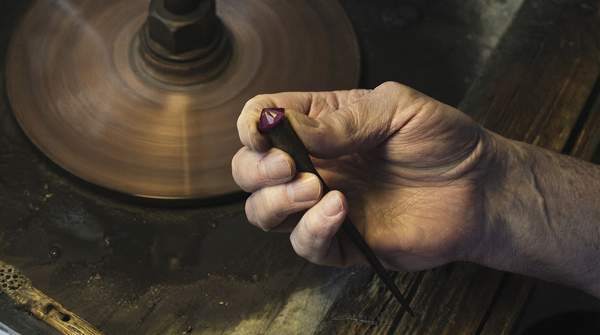
Gemstone cutting divides into two fundamental philosophies: traditional hand faceting, which trades equipment for human skill, time, and artistic interpretation, and machine-assisted cutting, which delivers geometric precision, speed, and consistency. Laser technology complicates the picture—not as a faceting tool, but as a means of splitting and marking rough stones. The choice between methods is ultimately a trade-off between artistic yield and mechanical perfection, and in every case the final value of the gem rests on the quality of the cut, whichever route produced it.
Traditional Hand-Cutting: Artistry and Skill
Traditional hand faceting demands little equipment but a great deal of the cutter. According to GemsNY's guide to the cutting process, the hand approach "takes less equipment but more skill and time to produce any form of artistic patterns," whereas machine faceting produces "precise but mechanical designs." This distinction frames the entire comparison: the hand cutter's value lies in interpretation, not repeatability.
The Rare Gemstone Company's account of the process describes the tools—a lap primed with very fine diamond powder, each facet polished individually to a high sheen—and the human dimension behind them. "A good cutter will perform each step with intuition and skill leading to a symmetrical, scintillating, beautiful finished piece," the company explains, noting that it takes many years to reach competence and that highly skilled cutters are revered in the trade for their ability to visualize how a piece of rough can be transformed while balancing competing considerations along the way.
That judgment carries risk. Where a machine repeats an angle exactly, a hand cutter's error in angle or polish diminishes the stone. The offsetting benefit is uniqueness: hand work permits non-standard, artistic designs, particularly suited to unusual rough that a standardized process cannot accommodate. The method is labor-intensive by definition, and its ceiling is set by the individual cutter's experience rather than by the precision of the apparatus.