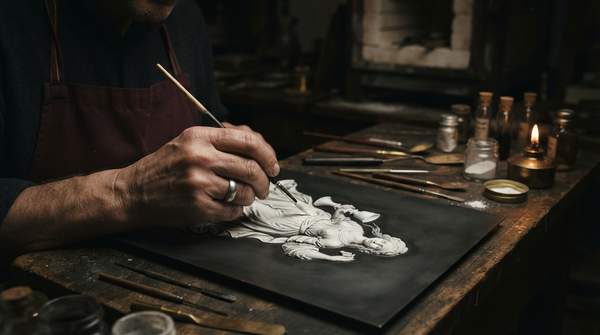
Grisaille enamel is a monochrome painting technique in which opaque white enamel is applied in layers of varying thickness over a black or dark blue enamel ground, so that thick coats read as highlights and thin coats let the dark base tone the white into gray. The result is a monochromatic image with half-tones and a convincing illusion of three-dimensional relief. The method originated as an enamel technique in 16th-century France, where the Limoges school and the Pénicaud family made it their own, and it survives today in modern opalescent variants.
The Historical Roots of Grisaille Enamel
The word itself points to the effect. As Nia Bowers explains in Art & Object, grisaille comes from the French gris, meaning "greyness," and the method reached its peak of prominence during the sixteenth century. She notes the technique was initially limited to underpainting but soon took on a life of its own in European artwork.
The technique's first home was painting, not enamel. Images were executed in shades of gray to create an illusion of sculpture, especially relief, a practice notably used by 15th-century Flemish painters. Enamelers adopted the same visual logic when they began painting white enamel over a dark ground, carrying the painter's chiaroscuro into fired glass on metal.
The transition to enamel is attributed to 16th-century France, specifically the Limoges school and the Pénicaud family, with figures such as Jean Pénicaud III credited by enameling references. The core principle of varying thickness for light and shade remained intact even as the medium changed from oil paint to vitreous enamel on a metal base.
Understanding Traditional Grisaille Enamel: A Step-by-Step Process
Traditional grisaille is painted work, and its essential structure follows from one governing relationship: the thickness of the white layer determines how light or dark each passage appears.
The process begins with the ground. The enamel base is fired in black or dark blue, a saturated dark surface that will later serve as the tonal shadow of the entire image. This dark ground is not merely a backdrop; it is the source of every gray tone in the finished piece.
Next, the enameler paints with white enamel. Lighter areas of the design are thickly painted, while gray areas are obtained by painting with thinner coats that allow the dark background color to tone the white enamel pigment. Highlights demand the most material; shadows demand the least.
The work then proceeds through repeated applications and firings, building half-tones gradually as each layer of white is adjusted in thickness. The final firing sets the full tonal range, and the piece emerges with the dramatic effect of light and shade that gives grisaille its sculptural presence. It is worth noting the technique is not in widespread use today, which makes surviving examples all the more concentrated expressions of the craft.