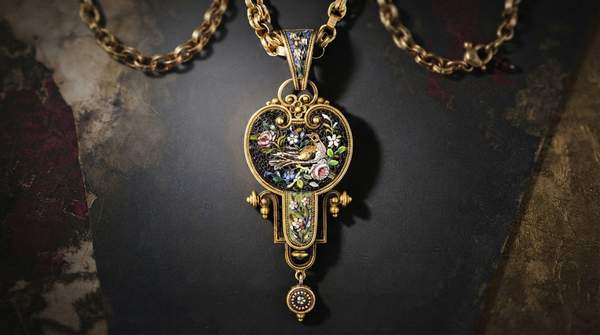
Antique Italian jewelry from the Grand Tour era falls into three recognizable regional traditions: micromosaics of tiny glass tesserae from Rome and the Vatican, pietra dura inlaid hard stones from Florence, and carved lava stone from Naples. Each craft answered the same demand—wealthy young Europeans traveling through Italy between the 17th and early 19th centuries wanted portable proof that they had seen the classical world—and each city answered it with its own materials and methods. Learning the three signatures is enough to place most surviving pieces.
The Grand Tour: A Journey of Culture and Collection
From the 17th to early 19th century, the Grand Tour was a customary journey through Europe, primarily to Italy, for young, upper-class European men of status and wealth. They typically embarked on this trip around age 21, often with a tutor or family member. The journey was framed as cultural education: travelers marveled at Roman ruins, Renaissance paintings, and the cities of antiquity.
Souvenirs were central to the ritual, and jewelry was among the most prized. As one jeweler's account puts it, micromosaic jewels were the glamorous "I was there" token of the 18th- and 19th-century traveler—a souvenir refined enough not to "scream tourist." The tradition declined as enthusiasm for classical culture waned and rail and steamship travel opened mass tourism in the 1870s, though Gilded Age Americans later adopted the pilgrimage for both sexes and older travelers. The jewelry the original tourists carried home remains the era's most tangible legacy.
Micromosaics: Roman Miniatures of Glass
Micromosaic is a meticulous mosaic technique using tiny Venetian glass tiles—tesserae—often under one millimeter wide. The glass, known as smalti, is melted and pulled over a flame into long, thin threads called filati, which are then shaped and cut with a file and tweezers into the individual tiles. Each tessera is placed by hand onto a prepared base of Roman stucco, made according to ancient recipes; as the stucco sets, it holds the mosaic firmly in place. The tesserae can be so small that a microscope may be needed to assemble them.
The technique, known in Italian as smalto filato, mosaico minuto, and mosaico in piccolo, was developed in 18th-century Rome, and the Vatican became one of its foremost production centers during the Grand Tour era. Vatican craftsmen used glass tesserae to make replicas of famous paintings. Giacomo Raffaelli (1753–1836) is often called the founding father of micromosaics; he famously reproduced the Roman mosaic "The Doves of Pliny," discovered in 1737, in micromosaic in 1779. Surviving pieces range from brooches to earrings—one pair of Egyptian Revival pendant earrings, made in the Vatican around 1850–1860, renders pharaoh portraits in the technique and sets them in 18-carat gold.