Choosing among the Emerald, Asscher, and Radiant cuts comes down to one fundamental question: do you want the quiet, mirror-like flashes of a step-cut or the intense, scattered sparkle of a brilliant-style hybrid? The Emerald and Asscher are both step-cuts that share angular, clean lines and a "hall of mirrors" optical effect emphasizing clarity over sparkle, while the Radiant—patented in 1977—applies a full brilliant facet pattern to a rectangular or square outline. Here is how the three compare on shape, light performance, history, and style.
Understanding Diamond Cuts: Emerald, Asscher, and Radiant
The three cuts can look deceptively similar in outline. As the Gemological Institute of America's diamond shape guide notes, cuts like emerald, radiant, and Asscher "may look similar in outline (rectangular or square) but differ in how their facets are arranged." That facet arrangement is what determines how light reflects and refracts inside the stone, shaping its sparkle, brilliance, and overall look.
Some names describe both an outline and a specific facet pattern—the emerald cut is one of these—while others, like the standard round brilliant, refer to a highly defined style. The Emerald and Asscher belong to the step-cut family, with long, parallel facets. The Radiant breaks from that tradition: it is a rectangular or square diamond with trimmed corners and a brilliant-style facet pattern covering both its crown and pavilion, as fine jeweler Gabriel & Co. describes.
This article compares the standard versions of each cut; it does not cover proprietary or branded variations, and it does not address pricing, which depends on cut quality, color, clarity, carat weight, and market conditions.
The 'Hall of Mirrors' vs. Brilliant Sparkle: Optical Effects Explained
Step-cuts and brilliant-cuts produce two fundamentally different kinds of light behavior. As one diamond comparison guide explains, the Asscher and emerald cuts "share a similar step-like facet structure that produces a hall-of-mirrors effect, which emphasizes the stone's clarity rather than its sparkle." The result is broad, elegant flashes of light and mirror-like depth rather than the scattered glitter of a brilliant-cut stone.
This quiet light performance is a deliberate aesthetic, not a deficiency—Gabriel & Co. notes that before the radiant cut existed, fancy cuts like the emerald and Asscher were "elegant and architectural, but their step-cut facets produced a much quieter light performance" than round brilliants. Because step-cut facets are long and open, they emphasize the diamond's clarity and transparency, which means inclusions are more visible and higher clarity grades are generally advisable.
The Radiant answers that trade-off. According to the Diamond Source of Virginia, it was "the first rectangular cut to have a complete brilliant facet pattern applied to both the crown and pavilion," making it "a much more dazzling and brilliant diamond than the simple emerald cut." With 70 facets, its faceting is reminiscent of the round brilliant, giving it considerable fire and sparkle—a description of optical character, not a quantitative light-performance measurement.
Diamond Cut Comparison: Emerald, Asscher, and Radiant
The table below categorizes each cut across five attributes—shape, facet style, light performance, historical association, and aesthetic style—so the core trade-offs are visible side by side. Read down a column to see a cut's full character; read across a row to compare the three on a single decision factor.
| Attribute | Emerald Cut | Asscher Cut | Radiant Cut |
|---|---|---|---|
| Primary Shape | Rectangular | Square with cropped corners, giving an octagonal appearance | Rectangular or square with trimmed corners |
| Facet Style | Long, open step-cut facets | Step-cut facets, similar to the emerald cut | Brilliant-style facet pattern on both crown and pavilion; about 70 facets |
| Optical Effect | "Hall of mirrors" flashes emphasizing clarity and transparency | "Hall of mirrors" effect in a compact form, with optical depth | Dazzling fire and sparkle; more forgiving of minor inclusions than step-cuts |
| Historical Era / Association | Timeless elegance; classic designs, remaining popular across eras | Developed in 1902 by Joseph Asscher; popular during the Art Deco era, now resurgent | Created and patented in 1977 by diamond cutter Henry Grossbard |
| Aesthetic Style | Sleek, sophisticated, minimalist | Art Deco geometry and vintage-inspired appeal | Modern brilliance and versatility |
The evidence points to a clear verdict: choose the Emerald or Asscher if you prefer geometric flashes and vintage-adjacent style, and the Radiant if you want modern sparkle in a rectangular or squarish shape.
Emerald Cut: Sleek Sophistication and Timeless Elegance
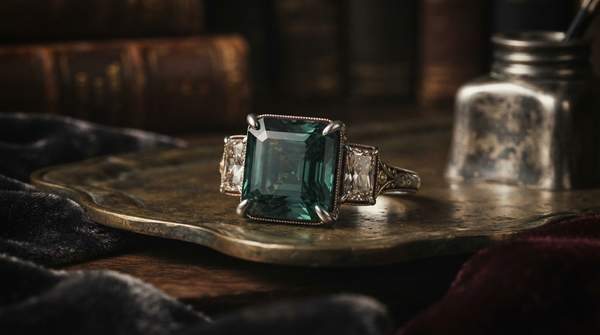
The Emerald cut's defining features are its rectangular outline and long, open step-cut facets, which produce broad flashes of light rather than scattered sparkle. Its hall-of-mirrors effect highlights the stone's clarity and symmetry, giving it what Gabriel & Co. calls "understated elegance" against more sparkling alternatives.
GIA's guide captures its character as "sleek sophistication," and its reputation has endured: it regained popularity in the early twentieth century and remains a classic choice for vintage-inspired and modern designs alike. Its extended length also creates a graceful visual flow across the finger, which Royal Asscher's comparison guide notes can be flattering on wider or shorter hands by subtly elongating the fingers' appearance.
Because its emphasis on clean lines and transparency leaves inclusions more visible, understated settings that highlight the diamond's inherent elegance are the natural pairing—these are aesthetic recommendations, not claims about structural security.
Asscher Cut: Art Deco Geometry and Vintage Allure
The Asscher cut compresses the step-cut aesthetic into a square frame with distinctly cropped corners, giving it an octagonal appearance. Its facets follow the same step-like structure as the emerald cut, so it produces a similar hall-of-mirrors effect—but in a compact form, with a high crown and small table contributing to its unique optical depth.
Historically, the cut was developed in 1902 by Joseph Asscher of the Royal Asscher Diamond Company, and its popularity peaked during the Art Deco era, making it a symbol of that period's geometric precision. Its timeless design has ensured continued appeal: it is experiencing a resurgence in recent years, making it a classic choice for both vintage-inspired and modern settings.
For buyers drawn to early-twentieth-century design language, the Asscher is the most direct expression of Art Deco geometry among the three cuts—square, symmetrical, and architectural rather than sparkling.
Radiant Cut: Modern Brilliance with a Hybrid Sparkle
The Radiant is the youngest of the three and the only brilliant-style option in this comparison. Patented in 1977 by master diamond cutter Henry Grossbard, it was created to combine the best elements of the emerald and round brilliant cuts—matching the elegant geometry buyers associated with fancy shapes while capturing the sparkle that step-cuts sacrifice.
Technically, its octagonal outline and cropped corners resemble the emerald cut, but its faceting echoes the round brilliant, with roughly 70 facets arranged across crown and pavilion. That arrangement is designed to maximize brilliance and fire, and because light scatter masks imperfections better than open step facets, it is generally more forgiving of minor inclusions than the Emerald or Asscher.
Proportions have also evolved with fashion: Diamond Source of Virginia reports that while a length-to-width ratio near 1.5 was preferred a decade ago, ratios of 1.2 to 1.3 have become popular in recent years, and square radiants (1.05 or less) attract shoppers seeking a very bright square diamond. The cut also works well as a center stone for three-stone rings.
Choosing Your Diamond: Aesthetic Preferences and Design Pairings
The decision framework is straightforward once you separate the two light behaviors. If elegant, clear flashes of light and mirror-like depth appeal to you, the choice between the two step-cuts is about shape and era: the rectangular Emerald cut suits sleek, sophisticated, minimalist designs and elongates the finger, while the square Asscher suits Art Deco geometry and vintage-inspired settings.
If instead you want intense, scattered sparkle without abandoning a non-round outline, the Radiant is the only cut of the three engineered for it—a 1970s hybrid that delivers brilliant-cut fire in a trimmed-corner rectangle or square. Buyers who prioritize visual clarity performance in a step-cut should budget attention (and likely clarity grade) accordingly, since open facets make inclusions more visible.
These pairings reflect common aesthetic conventions described by jewelers and gemological sources, not engineering requirements; setting security is a separate question outside this comparison.
Making Your Choice: Flashes, Sparkle, and Style
Choose between an Emerald, Asscher, or Radiant cut diamond based on your preference for either the elegant, clear flashes of step-cuts or the intense, scattered sparkle of a brilliant hybrid cut, aligning the choice with your desired aesthetic and historical association. The Emerald offers timeless rectangular sophistication, the Asscher delivers 1902-vintage Art Deco geometry in an octagonal square, and the 1977 Radiant provides modern brilliance for those who want sparkle in a geometric outline.
You will know the decision is made when you can confidently identify the cut that best matches your personal aesthetic preference and intended jewelry design—and articulate why, in terms of its optical effect (hall-of-mirrors flashes versus brilliant sparkle) and its style associations, before you begin comparing individual stones.
Sources
- Radiant Brilliant Cut Diamond Shape — Diamondsourceva
- Guide to Diamond Shapes for Engagement Rings — GIA 4Cs
- What Is a Radiant Cut Diamond? Everything You Need to Know — Gabrielny
- Asscher Cut vs Emerald Cut: A Comparison Guide — Diamondrensu
- Radiant vs. Emerald Cut: Which Diamond Cut Shines More? — Gabrielny
- Royal Asscher Cut vs Emerald Cut
- Radiant Cut Diamond Guide: Cut, Clarity, Comparison • Taylor & Hart — Taylorandhart