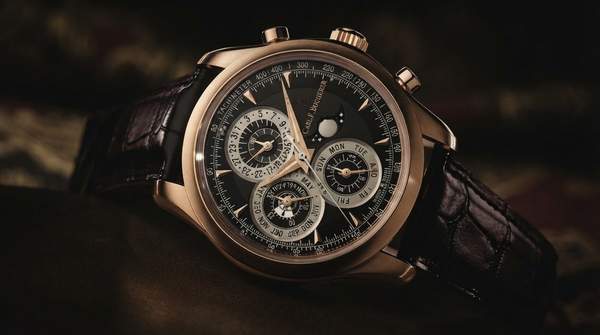
Choose a complication by matching its utility to your life, not its prestige. A GMT earns its keep for frequent travelers tracking a second time zone; a power reserve indicator serves manual-wind owners and multi-watch collectors; a moon phase is a piece of celestial artistry whose value is aesthetic rather than practical. The trade-off is real, and the right answer depends entirely on your priorities.
Understanding Watch Complications: More Than Just Time
A complication is any function a mechanical watch performs beyond telling time, and manufacturers grade them by ambition. NOMOS Glashütte distinguishes major complications—chronographs, tourbillons, alarms, repeaters, perpetual calendars—from simpler additions like the date, moon phase, second time zone, and the display of remaining power reserve, which the brand describes as very useful in everyday life. That hierarchy matters for buyers: the three complications considered here sit closer to the practical end, yet they serve entirely different purposes and signal different things about their owners.
GMT: The Traveler's Companion
A GMT displays a second time zone so the wearer can read home and local time simultaneously. Patek Philippe implements this with two hour hands, each indicating a different zone, plus day/night apertures that resolve the ambiguity a 24-hour cycle creates. EveryWatch, in its complications guide, identifies the GMT as something frequent travelers may use daily—making it one of the few complications whose value survives the most skeptical test, actual daily wear.
The aesthetic cost is moderate. Tufina Watches, whose article explains GMT and moon phase functions, notes that GMT functions integrate more efficiently into a case than chronographs, so the added dial information does not necessarily translate into added bulk. What it does add is visual density: an extra hand and a 24-hour scale are permanent residents of the dial.
Moon Phase: A Poetic Display of Time
The moon phase depicts the evolution of the moon as seen from Earth, generally through an aperture, occasionally by hand, according to Patek Philippe. Its accuracy varies meaningfully by execution. NOMOS explains that over about three years, the accumulating minutes of the real lunar cycle add up to one day requiring manual correction—while other designs aim for accuracy spanning a hundred or, in individual cases, a thousand years.
As practical equipment, it ranks low. One reader comment published by Gentleman's Gazette concedes that for most men who aren't collectors or horologists, a moon phase is nothing more than aesthetic appeal—"they just think it's neat." Tufina frames the same point without the dismissiveness: moon phases appeal more to aesthetic appreciation than practical necessity, and that is perfectly valid if it matters to you. Its value lies in conjuring celestial events on the wrist with mechanical and artistic means.