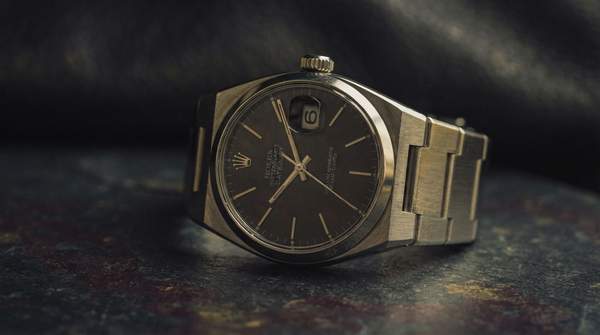
Luxury watch bracelets arrived at two rival engineering philosophies, and almost every iconic metal bracelet since descends from one of them. The separate-link bracelet, exemplified by the Rolex Oyster's robust three-piece construction, treats the bracelet as a durable, adaptable component attached to the case. The integrated bracelet, defined by the Patek Philippe Nautilus and the Audemars Piguet Royal Oak school of design, treats the bracelet as an inseparable extension of the case itself. Understanding that split explains most of what collectors weigh when they judge a bracelet's comfort, durability, and design integrity.
Separate-Link Bracelets: Engineering for Robustness and Versatility
The separate-link approach builds a bracelet from discrete, repeating elements. Its most famous expression is the Rolex Oyster, a three-piece link design whose robustness has made it a default: as repair specialists at Fast-Fix note, most modern divers and everyday watches use some variation of the Oyster, from Seiko to Tudor and beyond. That ubiquity is itself an engineering verdict. A flat, three-piece link architecture distributes load across broad contact surfaces, which is why the pattern suits watches intended for hard use.
Rolex's own variations show how the same modular logic serves different priorities. The Jubilee, which debuted in 1945 for the Datejust, is a five-piece link design that Fast-Fix describes as more flexible and dressy than the Oyster; its polished center links can scratch easily, but that is the trade-off accepted for extra shine and comfort. The President bracelet, exclusive to the Day-Date line, uses a three-piece semicircular link design—softer and rounder than the Oyster—and is positioned as luxury rather than utility. Three bracelets, one principle: links are assembled as a chain distinct from the case, and the character of the watch changes with the chain you choose.
The practical consequence of this construction is adaptability. Because the bracelet is a bolted-on assembly of links, its width, taper, and finish can be varied across a product line without redesigning the watch head. It is an engineering philosophy of robustness first, styling second—though Rolex's catalogue demonstrates how far styling can travel within it.
Integrated Bracelets: Seamless Design and Visual Harmony
The integrated bracelet inverts that logic. Here the bracelet is designed as an inseparable part of the watch's identity, and that premise demands greater design precision: the first link must flow from the case profile rather than attach beneath it. Outlook Luxe's Aaron Jacob frames the modern bracelet as having evolved "from little more than practical straps" into "some of the most sophisticated components in horology," and the integrated designs are where that sophistication is most visible.
The Patek Philippe Nautilus bracelet is a widely cited benchmark for elegant integrated sports-watch design. Across the Nautilus family, reference designations ending in "/1A" or "/1G"—the 5811/1G in white gold, the 5711/1A, the original Jumbo's 3700/1A and its smaller successor 3800/1A—consistently denote the integrated bracelet as a defining feature of the model, not an option. The same reference-number discipline appears in the 5980/1R's precious-metal integrated bracelet, while some variants, like the 5276/1A, are offered on bracelet and strap alternatives. The bracelet is written into the watch's name.
The engineering challenge is aesthetic as much as mechanical. To make metal flow seamlessly from case to clasp, the designer must solve articulation, taper, and finishing as one continuous problem. When it succeeds, the result is visual harmony and a unified aesthetic—a watch that reads as a single sculpted object on the wrist rather than a head with an attachment. That seamlessness is precisely what defines some of the most celebrated luxury sports watches.