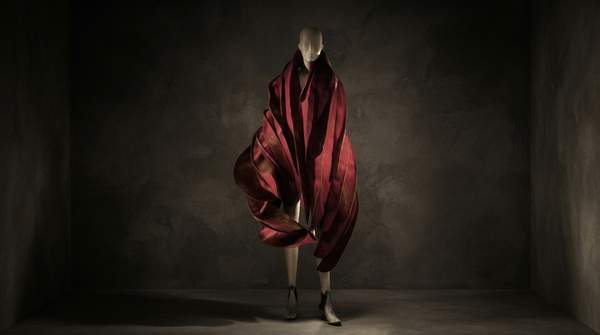
Haute couture's sustainability story now runs along two very different tracks. One rescues what already exists—scraps, offcuts, and discarded materials transformed through design ingenuity. The other builds textiles from scratch in bioreactors, where engineered microbes spin proteins into fibers. The essential distinction is this: upcycling extends the life of limited, inconsistent existing materials, while bio-engineering creates new materials with designed performance properties. Understanding that difference lets you read any luxury collection's sustainability claims with a sharper eye.
Redefining Luxury: Sustainable Innovation in Haute Couture
Why is the atelier suddenly a site of environmental reckoning? As the fast fashion model continues to dominate global clothing markets, researchers and industry stakeholders are increasingly exploring circular strategies that reduce environmental harm while maintaining economic viability, as Ananna Mostafiz notes in her comparative review of sustainable fashion design. Both upcycling and bio-engineering aim to extend the lifecycle of textile materials and reduce dependence on virgin resources—but they get there by opposite routes.
Within haute couture specifically, the stakes are aesthetic as much as ecological. A guide from the Roman tailoring house Sartoria Litrico observes that advanced sustainable materials not only help reduce waste but maintain high performance in strength and versatility, making them ideal for high fashion. Fashion education institution Istituto Marangoni goes further, arguing that contemporary biomaterial collaborations represent "a deep shift in luxury fashion" rather than conceptual gimmicks. Luxury, in other words, is being redefined at the level of the fiber itself.
Upcycling: Creative Reuse of Existing Materials
Upcycling begins with constraint. Reporting from North Carolina State University's Wilson College of Textiles, drawing on the doctoral dissertation of textile technology management researcher Hyesim Seo, describes how various design techniques—patching, cutting, adding, and material mixing—are employed to develop new designs from limited and inconsistent materials. The designer does not choose the fabric; the fabric's availability dictates the design. That limitation is precisely what gives upcycled couture its distinctive character.
The practice has moved from fringe to mainstream, with brands from mass-market labels to luxury designers embracing upcycled products, according to the Wilson College reporting. In haute couture, the clearest exemplar is Swiss designer Kevin Germanier, whom Deutsche Welle reported in February 2025 "combines haute couture with sustainability," finding inspiration for his creations in "scraps and material destined for the dumpster." The couture garment here is literally assembled from waste—rags to riches, as the reporting puts it.
Bio-Engineered Materials: Innovation from the Lab
Bio-engineering inverts the upcycling logic: instead of working with what exists, it manufactures what has never existed. Istituto Marangoni's account of biotech fashion describes how firms such as Bolt Threads and Spiber Inc. employ genetically modified microbes to ferment and yield spider silk proteins. These proteins are subsequently grown in bioreactors and transformed into advanced, biodegradable textile fibers. The material is not harvested from spiders but brewed, in a process closer to brewing than to weaving.
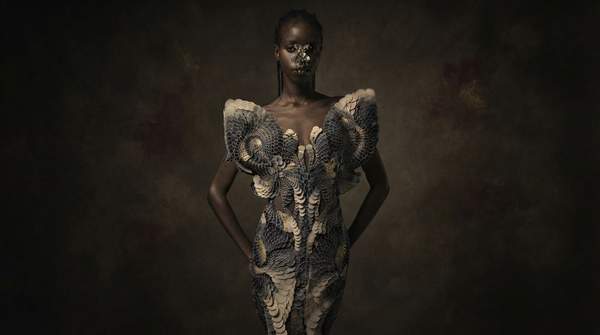
The couture applications are already documented. Bolt Threads collaborated with Stella McCartney and Adidas, while Spiber created a haute couture piece with Iris van Herpen using their Brewed Protein™ material, as reported by Vogue Business in 2023. Nor is fermentation the only laboratory route: Sartoria Litrico's guide describes Lyocell, produced from cellulose—often derived from eucalyptus—in a closed process that recycles almost all solvents and water. Other bio-based inputs include citrus by-products, as in Orange Fiber's textiles.
Comparative Overview: Upcycling vs. Bio-Engineered Materials in Haute Couture
The table below contrasts the two strategies across consistent criteria—material source, production process, key benefit, and a documented couture application—so the fundamental differences stand out at a glance. Read any brand's sustainability statement against these rows and you can identify which strategy is actually in play.
| Dimension | Upcycling | Bio-Engineered Materials |
|---|---|---|
| Material Source | Existing textile waste, scraps, and discarded materials—described as limited and inconsistent, often destined for the dumpster | Newly created inputs: wood pulp cellulose, citrus by-products, or proteins produced by genetically engineered microbes |
| Production Process | Design techniques such as patching, cutting, adding, and material mixing transform existing items into new designs | Advanced biotechnology: microbial fermentation in bioreactors for fibers like synthetic spider silk; closed-loop solvent recycling for Lyocell |
| Key Benefit | Extends the lifecycle of textile materials and reduces dependence on virgin resources, cutting waste | High performance in strength and versatility with designed, consistent properties—something that, per Istituto Marangoni, "exceeds mere sustainability" |
| Haute Couture Application Example | Kevin Germanier's couture creations, built from scraps and discarded material | Iris van Herpen's haute couture piece using Spiber's Brewed Protein™ material; Lyocell described as ideal for high fashion |
What the comparison isolates is a trade-off between control and circularity. Upcycling guarantees that no virgin material enters the garment, but the designer inherits irregular supply and inconsistent quality. Bio-engineering offers consistency and tunable performance, but the material must be manufactured—through fermentation or closed-loop chemical processing—before it ever reaches the atelier.
Design Implications and Future of Sustainable Luxury
For the designer, each path demands a different temperament. The upcycler works like a bricoleur, letting patching, cutting, and material mixing resolve the friction between incompatible scraps into a coherent silhouette. The biotech collaborator works more like a materials scientist: Istituto Marangoni frames the shift in almost philosophical terms, suggesting that "the designer becomes a biologist, the consumer a co-evolver, and the garment a living system."
Both strategies carry honest limitations. Upcycled couture cannot scale its material supply on demand, since its inputs are, by definition, finite and irregular. Bio-engineered fibers involve higher production costs, as Sartoria Litrico notes of advanced sustainable processes generally. Neither approach, on the evidence available, can yet be assigned a precise carbon footprint—the qualitative benefits are documented, the quantitative ones are not.
Navigating Sustainable Choices in Luxury Fashion
Haute couture brands and consumers seeking sustainable innovation must consider whether their priority is extending the life of existing materials through creative design (upcycling) or developing new, high-performance textiles with controlled properties (bio-engineering). The first honors circularity and the poetry of the discarded; the second offers consistency, performance, and a laboratory-born definition of luxury. Neither is the singular future of sustainable fashion—they are parallel experiments answering the same question from opposite directions.
The measurable indicator to watch is the emergence of new luxury collections explicitly featuring either creatively repurposed archival fabrics or novel bio-engineered textiles, alongside designer statements on their material choices. When the next couture week brings a Germanier-style scrap-built gown beside another Brewed Protein™ collaboration, you will know exactly which strategy you are looking at—and what it took to get there.
Sources
- Beyond Fast Fashion: A Comparative Review of Upcycling and Recycling Strategies in Sustainable Fashion Design — Rsisinternational
- Sustainable Fabrics in Haute Tailoring: An Essential Guide — Sartoria Litrico
- Biotech Fashion: The Future of Sustainable Luxury Textiles — ISTITUTOMARANGONI
- How Fashion Brands Are Embracing Upcycling — Wilson College of Textiles
- Upcycling turns trash into haute couture — DW