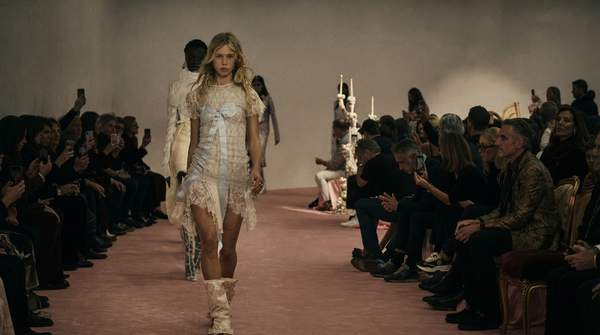
The fashion show began as a private sales ritual and became a global broadcast. That is the whole arc of the form in a single sentence: from an exclusive in-house presentation of haute couture staged for a vetted private clientele, as the fashion encyclopedist's account puts it, to a biannual spectacle of couture and ready-to-wear consumed by mass media, the industry, and a vast cross-section of the public. The staging evolved in four broad eras — the intimate salon, the theatrical parade, the brand spectacle, and the immersive broadcast — and each shift tracked a change in who the show was actually for.
Evolution of Fashion Show Staging: A Timeline
Before tracing the narrative, it helps to see the pattern at a glance. The chronology below sequences the major developments in how fashion has been presented and for whom, and it makes visible the underlying trajectory: each era widened the audience while changing what the show was strategically meant to accomplish.
| Era | Key Staging Characteristics | Pioneering Figures/Brands | Primary Audience |
|---|---|---|---|
| The Salon Presentation (1870s–1900s) | Intimate presentations in Parisian couture salons using live models; earlier, shop assistants wore creations in-house, and wives promenaded designs in public parks | Charles Frederick Worth | A carefully vetted few: wealthy clients, later supplemented by retail buyers and press |
| The Theatrical Parade (1910s–1960s) | Designs shown in motion; models moved beyond the salon into public spaces and lavish events | Paul Poiret; Christian Dior (1947 "New Look" collection) | Expanding industry audience of buyers, editors and journalists, alongside clients |
| The Brand Spectacle (1970s–1990s) | Large-scale theatrical runway shows; growing press attention and the modeling profession's rise | Major couture and ready-to-wear houses | Mass media and consumers, alongside industry insiders |
| The Immersive Broadcast (2000s–Present) | Livestreamed shows and social media distribution; shows as permanently recorded performances | Alexander McQueen (Plato's Atlantis, 2009), with Nick Knight and SHOWstudio | Global viewership and social media followers |
One caveat belongs here: the boundaries between these eras are a synthesis drawn from the historical accounts, not dates any single source declares. The 1970s start of the brand spectacle and the 2000s start of the immersive broadcast are periodizations inferred from the evidence — the latter anchored concretely by the first livestreamed show in 2009.
The Intimate Salon: Birth of Couture Presentation (1870s-1900s)
In nineteenth-century Paris, showing clothes was a shop-floor practice before it was an event. It was common, as the Encyclopedia.com account records, for dressmaker houses to have their assistants or saleswomen — the demoiselles du magasin — wear the designer's creations while working. Display was functional: the garment had to be seen on a body before it could be sold. From roughly the 1870s, when Charles Frederick Worth established the modern fashion system, haute couture ruled, and its presentations stayed close to this commercial origin.
Worth, credited as the father of haute couture, was the first to use live models in his salon, and he also pushed display into the city itself: the encyclopedic account describes him dressing his wife in the latest styles to promenade in socially important areas such as the Bois de Boulogne. The salon show, meanwhile, remained exclusive and intimate, as the academic analysis of the fashion show as a cultural form notes — often taking place in the couture salons of famous designers, with the elite audience later supplemented by retail buyers.
And "elite" meant something precise. As Highsnobiety's history of the show recounts, a woman could not simply be rich to walk into a couture salon, much less be invited to a show; she had to be carefully vetted, with an impeccable high-society reputation. An American couture debutante who stayed at the wrong hotel during her Paris shopping jaunt could be disqualified on that basis alone. Direct relationships with the "right" clients were the heart of the business, and the show existed to serve them.
The Theatrical Parade: Moving Beyond the Salon (1910s-1960s)
The first crack in the salon's exclusivity came from a designer who wanted his clothes to move. Paul Poiret, one of the founding fathers of haute couture, experimented with fashion shows in the 1900s, as British Vogue's history by Emily Zak recounts, and pioneered taking models out of the salon and into public spaces for showcases. The impulse was theatrical: Poiret wanted to show his designs in motion, an ambition Zak likens to modern designers who have used carousels, travelators and experimental choreography in their shows. The parade, not the fitting room, became the unit of presentation.
Through the middle of the century the audience broadened without ceasing to be select. The classical Parisian couture show remained intimate, but its elite client base was increasingly supplemented by retail buyers and by the press — an audience of professionals whose presence changed what a show had to communicate. Relationships with editors mattered as much as relationships with clients: when Christian Dior presented his seminal 1947 collection, it had no name at all. The moniker "The New Look" was the doing of Carmel Snow, then editor-in-chief of Harper's Bazaar — a small episode that shows how the show's meaning was now co-produced by media gatekeepers.
By the 1960s the form retained, in the encyclopedist's phrase, links to its origins in theatrical display and the couture salon shows of the early twentieth century — but the balance had tipped. The clothes were still the main event, as Highsnobiery frames the period, reserved for three camps: clients, editors, and buyers. What came next would dissolve that triad.
The Brand Spectacle: Mass Entertainment and Supermodels (1970s-1990s)
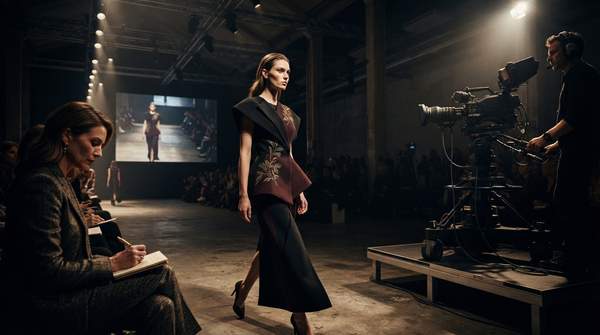
After World War II, ready-to-wear rose as an industry, and the fashion show changed shape around it. The encyclopedic account identifies the forces behind the transformation plainly: increased consumer awareness of Parisian couture, the rise of ready-to-wear, the growth of the modeling profession, and the increasing attention paid to the runway by the popular press. A show staged twice yearly for a private clientele became a biannual spectacle seen by a vast cross-section of consumers, the mass media, and the fashion industry.
The strategic purpose shifted accordingly. Where the salon show sold garments to the women in the room, the spectacle sold a brand image to everyone watching — and "everyone watching" was now a measurable mass. The runway's theatrical inheritance, present since Poiret, was scaled up into large-scale staged entertainment, with the modeling profession turning individual walkers into figures of mass fascination. The show became, in effect, an advertisement that performed itself live.
This is the era in which the seeds of the modern inversion were planted. Once the popular press treated the runway as entertainment, the pomp surrounding the clothes began to compete with the clothes themselves — a tension that would only sharpen once every attendee carried a broadcast device in their pocket.
The Immersive Broadcast: Digital Reach and Global Audiences (2000s-Present)
The pivot point can be dated precisely. On October 6, 2009, Alexander McQueen's Spring/Summer 2010 show, Plato's Atlantis, became the first ever live streamed fashion show. SHOWstudio, under the direction of Nick Knight and with support from IMG, streamed the presentation live from Paris — what would prove to be Lee Alexander McQueen's final catwalk show, staged in an indoor arena in the city's 12th arrondissement and inspired, as Dazed recounts, by the idea of a humanity that returns to the oceans.
The consequence was immediate and structural. McQueen's pioneering livestream is considered a turning point for fashion, contributing to a shift in the popular conception of runway shows. Once intimate presentations reserved for a select audience of clients, editors, and buyers S1fd14608:P3, fashion shows evolved into global spectacles S5bb4e1ec:P1, reaching millions S3b6d4c4a:P17. Social media then added a new space where audiences could immediately discuss each collection after shows ended.
The industry's response left no ambiguity about the format's value: for Autumn/Winter 2010, the season following Plato's Atlantis, all major fashion houses livestreamed their fashion week shows. The once-secretive world of fashion, as Dazed observes, had been opened to outsiders — the show was no longer the reserve of a rarefied few.
Evolution of the Fashion Show Audience
Seen across the whole arc, the staging innovations were never purely aesthetic; they tracked a business strategy. The correlation between evolving staging and evolving objectives is inferred from the chronology rather than stated in any single source, but the pattern is consistent: each new format answered the question of who the show was for.
Four audience figures succeed one another. First, the vetted couture client — wealthy, reputationally impeccable, courted directly. Second, the industry buyer and editor, whose professional presence made the show a marketplace and a press event; Dior's unnamed 1947 collection becoming "The New Look" through an editor's coinage shows how much power had migrated to this group. Third, the mass-media public of the spectacle era, watching the runway through the popular press.
Fourth — and this categorization is a synthesis of the described audience expansion rather than a direct quote from any source — the celebrity influencer and the global social media follower, for whom the show is content to be broadcast in the moment. Highsnobiety captures the endpoint vividly: when the show starts, virtually everyone whips out their phone to broadcast it to their followers, and few attendees bother to look at the actual clothes.
Whether that final state is evolution or devolution depends, as that same account allows, on one's vantage point. What is not in dispute is the direction of travel: from a room one had to be vetted to enter, to a stream anyone with a connection can watch.
The Enduring Spectacle: Adapting to Future Audiences
The decision this history supports is clear: fashion shows will continue to evolve by embracing new technologies and formats to engage an ever-broadening global audience, maintaining their role as critical brand communication tools. The salon show served a business of direct relationships; the livestream serves a business of global image-making. Each era's staging answered its era's commercial logic, and there is no evidence the logic has stopped moving.
The measurable indicator to watch is continued experimentation with digital platforms, interactive experiences, and diverse venues for fashion presentations. The precedent is concrete: one designer's livestream in October 2009 became an industry-wide practice within a single season. If a comparable format shift arrives, history suggests it will be legible the same way — in how quickly, and how completely, the major houses follow.