Wood and straw marquetry look related at a glance, but they are two distinct crafts. Wood marquetry builds pictorial patterns from thin contrasting veneers, prized for deep grain and natural color variation. Straw marquetry builds surfaces from split, flattened rye straw, prized instead for an iridescent shimmer that shifts with the light. Understanding the difference in material, tool, and assembly is the key to recognizing each technique in furniture, accessories, and interiors — and to knowing which one a luxury project actually calls for.
Introduction to Marquetry: An Art of Inlay
Marquetry is the intricate art of applying pieces of veneer to a surface to create decorative patterns, a craft admired for centuries. Writing from the design house Lemieux et Cie, historians of the technique trace its origins to ancient Egypt and its zenith to the 17th and 18th centuries, particularly in France and Italy. What distinguishes marquetry from its cousins is composition: as the Paris flooring specialist OscarOno explains, ordinary parquet repeats one geometric pattern across a room, while marquetry composes — borders, stars, medallions, inlaid squares, sometimes whole pictures — from shapes cut in contrasting woods or in a single wood with its grain turned. The same logic of composed picture-making extends beyond wood. In the 20th century, artisans applied it to an unlikely material: rye straw.
The Craft of Wood Marquetry: Tradition and Precision
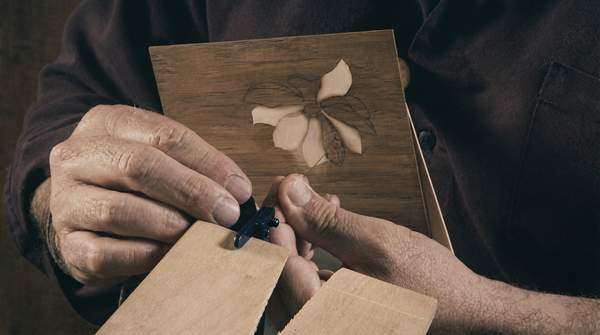
Wood marquetry begins with thin veneers cut from logs, often in contrasting species so that one design element reads against another. The maker cuts individual pieces, fits them together into a design, and glues the assembled picture onto a backing surface, producing a single cohesive panel. The aesthetic payoff is the material itself: rich wood grains, natural color variation, and the capacity for intricate pictorial work ranging from a single inlaid centerpiece to fully composed workshop panels with contrasting inserts.
Because wood carries its own figure — the way grain curls, flames, or stripes across a board — a marquetry design can exploit grain direction itself as a design element, turning one species into two visual tones. This pictorial ambition is what carried the craft through its Renaissance-to-18th-century flourishing on fine cabinetry, and it remains the reason wood marquetry is specified when a designer wants depth, warmth, and representational complexity.
Straw Marquetry: From Humble Beginnings to Luxury Art
Straw marquetry replaces veneer with rye straw, and the change of material transforms the entire process. Artisans working with the technique describe a preparation stage wood marquetry never needs: each piece of straw is split, flattened, and often dyed by hand, with color varying between harvests — a variation that Studio Ziricote, a maker of bespoke straw furniture, treats as part of the material's character. Shaping is done with a scalpel or knife for precise cutting and a bone folder for flattening, traditional hand tools that keep the work meticulous and free of power equipment.
Assembly is equally manual: pieces are cut exactly and glued edge to edge onto a substrate, frequently with water-based glue, so the joins read as a continuous surface. The signature result is the straw's natural silica coating. Once each piece is flattened and polished, light reflects differently across the surface, producing the shimmer and light-play that no wood veneer reproduces. In short, wood marquetry draws pictures; straw marquetry captures light.
Historical Trajectories and the 20th-Century Revival of Straw Marquetry
The two crafts traveled very different roads. Wood marquetry enjoyed an unbroken prestige lineage from its 17th- and 18th-century peak in France and Italy into modern collecting — Lemieux et Cie points to pieces such as Jean Royère's 1958 "Étoile" sideboard, which pairs straw marquetry with an oak interior, as evidence of the craft's continued hold on high design. Straw marquetry's story is one of neglect and rescue. It found fashionable favor during the Art Deco period — the period associated with the decorator André Groult — but as Australian Wood Review recounts, that popularity faded when the movement ended, and the craft was once more neglected.
The revival came in the 1980s through Groult's granddaughter, Lison de Caunes. Surrounded since childhood by straw-covered objects, she began by restoring Art Deco straw furniture then back in fashion, and promoted the craft through contemporary creations with a modern aesthetic. After many years of that work, straw marquetry is recognized worldwide as a refined craft, with workshops on nearly every continent developing their own techniques. In 2015 she launched Lison de Caunes Création, a line of furniture, wall panels, and objects, and her work now appears in interiors by Peter Marino, Jean-Louis Deniot, and Frank de Biasi, among other clients.
Technical Comparison: Wood vs. Straw Marquetry
The five dimensions below condense the essential differences between the crafts, from raw material to finished effect. Reading down each column shows why the two techniques, though built on the same composing logic, produce opposite visual experiences and suit different applications.
| Dimension | Wood Marquetry | Straw Marquetry |
|---|---|---|
| Material Source & Prep | Thin veneers cut from logs, often contrasting or exotic species | Rye straw, split and flattened by hand, often dyed; color varies between harvests; each piece prepared individually |
| Cutting & Shaping Tools | Shapes cut from veneer for fitting into composed designs (borders, stars, medallions, pictures) | Scalpel or knife for precise cutting; bone folder for flattening and shaping — no power tools |
| Assembly Method | Pieces cut and fitted into a design, then glued onto a backing surface as one cohesive panel | Pieces cut exactly and glued edge to edge onto a substrate, often with water-based glue; entirely manual, seamless joins |
| Key Aesthetic Qualities | Rich grain, natural color variation, capacity for intricate pictorial designs | Iridescent shimmer from natural silica, flattened and polished so light reflects differently across the surface |
| Typical Luxury Applications | Fine cabinetry, composed panels and flooring centerpieces | Cabinet fronts, console tops, headboards, feature wall inserts, screens, jewelry boxes, trays, mirrors, lamp bases |
The comparison reveals a clear pattern: wood marquetry's value proposition is pictorial complexity rooted in the material's own figure, while straw marquetry's is luminosity rooted in silica's light response. Their application ranges follow directly from those properties.
Applications in Luxury Design: Where Each Craft Shines
Straw marquetry earns its place where surfaces are seen at close range and in varied light. Make Bespoke Studio, which works with specialist straw artisans on luxury furniture and joinery commissions, names cabinet fronts, console tops, headboard panels, and feature wall inserts as the technique's natural territory. Studio Ziricote extends the inventory: room-divider screens framed in brass or lacquered wood, and small decorative objects — mirrors, lamp bases, jewelry boxes, trays — where small pieces showcase the precision and delicacy that introduce the technique to a space.
Seating and bed furniture are possible but less common for sitting surfaces, achievable with resin protection, and master ébénistes combine straw panels with other luxury finishes. Wood marquetry, by contrast, carries the tradition forward where pictorial depth and grain are the point, from fine cabinetmaking to composed flooring. These are cited examples of current practice, not a survey of the whole market — but they map where each craft is genuinely chosen today.
Choosing the Right Marquetry for Luxury Design
When selecting marquetry for a luxury application, consider whether the desired aesthetic is the deep, natural grain and pictorial complexity of wood, or the iridescent shimmer and light-play of straw. The deciding test is the visual effect of light interaction with the finished surface, and the material's inherent texture and pattern: a straw piece announces itself the moment you move past it and the shimmer shifts; a wood marquetry piece rewards stillness and close inspection of its grain and fitted composition. That single observable difference — how light behaves on the surface, and whether the design reads as picture or as glow — is the measurable indicator that tells you which technique you are looking at, and which one your project needs.
Sources
- The Beauty of Marquetry: A Historical Craft in Modern Application — Lemieux et Cie
- Marquetry Flooring: What It Is and How It Is Made — OscarOno Paris
- Bespoke Straw Marquetry Furniture & Wall Panels — Studio Ziricote
- The art and craft of straw marquetry - Australian Wood Review — Woodreview
- Makebespoke