Strip away the branding and the boutique lighting, and the difference between a wallet that lasts decades and one that fails at a seam often comes down to a single choice of stitch. The hand-sewn saddle stitch—two needles, one thread, worked through pre-punched holes—produces a seam in which each stitch behaves as an independent knot. Break one thread and the rest hold. The machine lockstitch, by contrast, is a chain: two separate threads interlocked at the core of the leather, where a single break can compromise the entire line. That structural distinction, more than any logo, is what luxury leather pricing quietly encodes.
The Foundation of Luxury: Hand-Stitching vs. Machine Stitching
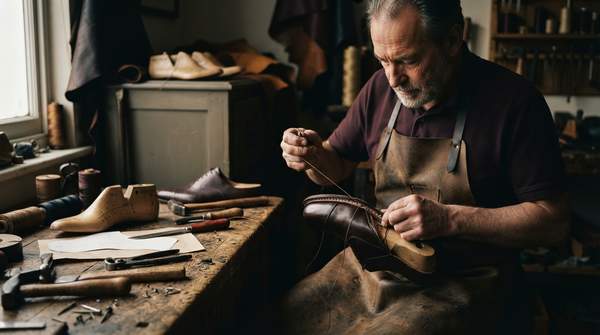
Every leather good begins with a joining problem, and there are only two broad answers. A machine passes two separate threads through the leather and interlocks them at the heart of the material—the lockstitch, the ubiquitous method of mass production. A craftsperson, meanwhile, may punch each hole by hand and pass a single thread through from both sides, creating interlocking loops along the seam. As SELVANE's editorial team frames it, stitching is "the silent language of construction, the invisible architecture that binds disparate pieces of exquisite material into a cohesive whole."
The two approaches optimize for different things. Machine stitching offers speed, consistency across vast quantities, and significantly reduced labor costs—entirely appropriate, as SELVANE concedes, for mass-produced items. Hand-stitching optimizes for resilience and repairability. Neither is universally superior; the question is which failure mode you can live with on an object meant to be carried, flexed, and stressed daily.
Saddle Stitch: The Gold Standard of Durability
The saddle stitch is mechanically simple and, for that reason, remarkably robust. One length of thread, two needles: each needle passes through the same hole from opposite sides, so the loops interlock within the leather itself. The result is a seam where every stitch functions as a discrete fastening rather than a link in a continuous chain.
Why does that matter? Consider the failure scenario. If a thread rips in a lockstitched seam, the integrity of the entire stitching line is compromised. If a thread rips in a saddle stitch, only the point of the rip is affected; the remaining stitches hold, and a repair can be made at the damaged spot rather than along the whole seam. The technique's provenance explains its over-engineering: it descends from horse saddles, where a failed seam could have deadly consequences. Craig Wesley, writing for Anne Wesley, goes so far as to call it "possibly even the strongest stitch we know of"—a craftsman's claim, but one grounded in the stitch's redundant structure rather than marketing.
Beyond the Saddle Stitch: Other Durable Hand-Stitching Techniques
The saddle stitch is not the only functional hand technique, and the International Leather Club's taxonomy is useful here because it classifies stitches by purpose rather than prestige. Single and saddle stitches sew multiple leather pieces on top of one another. Cross and baseball stitches attach leather side by side—with baseball stitching having the additional goal of pressing the leather against an object. Box stitching, meanwhile, is designed to be more functional in areas requiring sharp corners.
Notice what this taxonomy implies: stitch selection is an engineering decision, not an aesthetic one. A structured bag with crisp architectural corners calls for a different technique than a seam meant to wrap leather around a form. As the Club puts it, if the stitching method achieves its goals, it can be considered functional regardless of appearance. Luxury goods simply layer beauty on top of that logic.
The Machine Lockstitch: Efficiency with a Trade-off
To be fair to the machine, the lockstitch is not a defective stitch—it is a stitch with a known failure profile. Its two threads interlock at the heart of the leather, which produces a clean, consistent seam at speeds no hand can match. But as SELVANE's editorial observes, "the lock stitch, by its very design, has a single point of failure."
The everyday analogy is familiar to anyone who has pulled a loose thread on a shirt and watched a foot or more of stitching vanish. The same chain reaction governs a lockstitched leather seam under stress: each stitch depends on the integrity of the next. On a garment, that is an annoyance. On a bag strap bearing weight, it is a structural liability. This is not to say machine stitching is shoddy—most high-end designer handbags, as Wesley notes, are machine-stitched despite commanding prices comparable to monthly rent or mortgage payments. It is to say the buyer should know which architecture they are paying for.
Comparing Luxury Leather Stitching Techniques
The table below contrasts the four stitches across construction, durability, application, and appearance. Note that the evidence supports detailed construction and durability claims only for the saddle stitch and lockstitch; for the box and baseball stitches, the record is strongest on their intended applications.
| Stitch | Construction Method | Durability Mechanism | Common Applications | Aesthetic |
|---|---|---|---|---|
| Saddle Stitch | Two needles with a single thread; each needle passes through the same hole, forming interlocking loops on both sides of the leather; done by hand | Each stitch acts as an independent fastening—a break compromises only the point of the rip, and the seam does not unravel | High-end wallets, travel bags, and leather goods built for longevity; historically horse saddles | Distinct, consistent hand-worked stitch line; considered the gold standard of luxury leathercraft |
| Machine Lockstitch | Two separate threads interlocked at the heart of the leather, typically by sewing machine | Chain-like construction; a single thread break can compromise the entire stitching line | Mass-produced leather goods, including most high-end designer handbags | Uniform, precise, machine-consistent seam |
| Box Stitch | Hand technique; specific construction details not established in the sources reviewed | Valued for function in areas requiring sharp corners | Leather goods with crisp, angular corner construction | Functional; appearance secondary to purpose |
| Baseball Stitch | Hand technique; specific construction details not established in the sources reviewed | Attaches leather side by side with the added goal of pressing leather against an object | Seams where leather must be joined and held against a form | Functional; appearance secondary to purpose |
Read across the rows and the pattern is clear: the two stitches with fully documented construction differ most in their failure behavior, while the box and baseball stitches earn their place through specialized geometry and application rather than raw seam strength.
Craftsmanship's Price: Time, Skill, and Longevity
What does the hand premium actually buy? Time, mostly. Wesley offers a concrete comparison: a proficient machine stitcher can finish a simple passport wallet in under a minute, while even an experienced leather craftsman will take roughly forty-five minutes to an hour to punch the holes and saddle stitch the same item. That is a labor ratio on the order of fifty to one, before counting the skill required to keep a hand-sewn line consistent.
The scarcity is real, too. Wesley reports that Hermès is one of the only well-known brands still employing the technique, and estimates that the overwhelming majority of leather goods—including items sold at high-end department stores and even many marketed as handmade—are not hand-stitched. The premium, then, purchases three things: hours of skilled labor, a seam that can be repaired locally rather than replaced wholesale, and the visual signature of a hand-worked line.
Making an Informed Choice: Recognizing Quality Stitching
When evaluating luxury leather goods, prioritize items featuring a hand-sewn saddle stitch for superior durability and longevity, especially in high-stress areas such as straps, hinges, and wallet spines. The premium is not purely symbolic—it maps to a measurably different failure mode and a repairable seam.
How can you verify it? Look for the distinct, slightly slanted, consistent stitches characteristic of hand-sewing, and remember the diagnostic test: a broken thread that unravels the entire seam indicates a machine lockstitch, while a seam that remains intact around a single break indicates a saddle stitch. Ask the seller directly which stitch was used, and treat "handmade" labeling with caution, since machine stitching can be part of an otherwise hand-finished product. The stitch line, examined closely, will tell you more than the price tag will.
Sources
- Luxury Leather Stitching: Saddle Stitch Secrets — SELVANE
- What is a Saddle Stitch in Leatherworking & Why is it Better Than Machine Stitching? — Anne Wesley
- ILC - Types of Leather Stitches - Variations and When to Use Them — International Leather Club