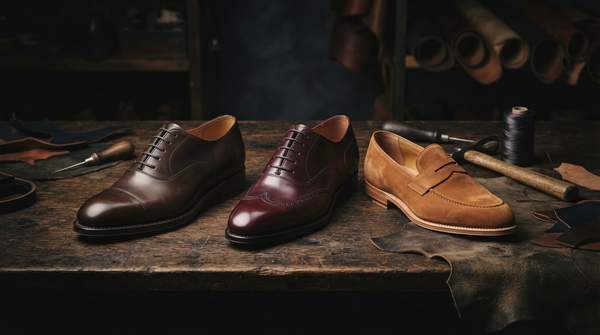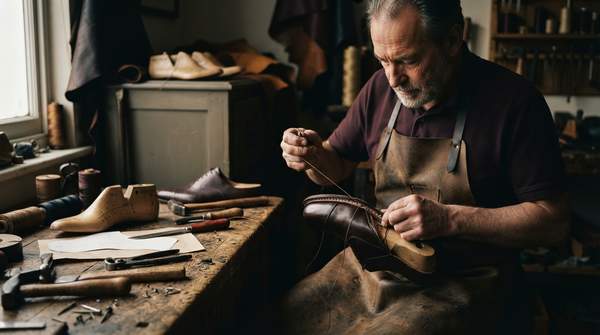
How does a pair of shoes come to fit one human foot—and only that foot? The answer lies in a process that begins not with leather but with wood, and not with stitching but with scrutiny. True bespoke shoemaking is defined by two non-negotiable features: a unique, hand-sculpted last made for each of the client's feet, and a prototype fitting that lets the maker correct the fit before the final shoes are ever built. Everything else in the craft—the pattern cutting, the lasting, the hand-stitched welt—flows from those two commitments. What follows is the full journey, stage by stage, and a way to tell genuine bespoke from the merely customized.
The Foundation of Bespoke: Initial Consultation and Last Creation
Every bespoke shoe begins with a conversation and a pair of feet. At the initial consultation, the shoemaker captures the client's anatomical data in detail: tracings of the foot, linear measurements, and notes on how the foot rolls during walking—observations that, as the Italian Shoe Factory describes, will influence factors as seemingly distant as heel height. The maker is not simply recording a size; he is recording a gait, a set of pressures, a way of moving through the world.
From this data, the last-maker sculpts a unique wooden last for each foot—a three-dimensional model around which the entire shoe will be built. This is the craft's foundational act. As the Italian Shoe Factory explains, the last is later placed inside the shoe so the upper can be modelled around it, and it is used again near completion to verify that the finished fit matches the original design. The last, in other words, is present at the beginning, the middle, and the end of the process: a wooden ghost of the client's foot that haunts every stage.
Why does this matter so much? Because a mass-production last is, by design, a compromise—a symmetrical, straighter form that takes no account of the anatomical particularities of any individual foot. A personal last inverts that logic entirely. The shoe exists to fit the foot, rather than the foot being asked to accommodate the shoe.
From Last to Leather: Pattern Cutting and Upper Construction
Once the last exists, the pattern cutter takes over, working from the client's measurements and the finished last. The first task, per the Italian Shoe Factory's account of the process, is a paper pattern for the chosen style, composed of pieces with wonderfully archaic names: vamp, cap, tongue, and quarters. These are the upper's constituent parts, and their geometry is dictated not by fashion alone but by the contours of that specific last.
Then comes the cutting of the leather itself, and here the cutter's judgment becomes an art of its own. The Italian Shoe Factory credits the cutter with the ability to assess a hide's weight and pliability and choose the perfect leather for the job—a skill of touch as much as training. Precision at this stage is not decorative; the pattern pieces must be cut so that the upper will conform exactly to the last's three-dimensional surface once assembled. A millimetre of error here becomes a wrinkle, a pinch, or a pressure point later.
It is worth pausing on how unusual this division of labour is. In a bespoke workshop, the last-maker, the cutter, and the finisher are distinct specialists, each handing the shoe to the next like relay runners. The client's foot is the baton—passed, in effect, from hand to hand until it reappears as a shoe.
The Critical Test: Prototype Fitting
Before full production begins, the client is invited back for a fitting—a trial shoe, often made from inexpensive leather, constructed to test how the design looks and fits on the actual foot. This is where bespoke earns its price. As the Italian Shoe Factory describes it, the client can request revisions such as heel height or the shape at the toe, and while the client wears the trial shoe, the master last-maker takes final measurements and even makes small incisions in the shoe to detect any pressure on the foot.
Think about what that means: the shoemaker is willing to cut into his own work to find where it hurts you. The fitting enables adjustments to the client's last—however tiny—before the final shoes are made. Comfort, in this tradition, is not assumed; it is verified empirically, on the foot itself.
The prototype is also the industry's honesty test. Maida's Bespoke Footwear is blunt about this: shops working from modified mass-production lasts do not make a prototype for your fit. If you receive no trial pair, your footwear was made on modified production lasts—and if the finished shoes don't fit, all such a shop can do, in Maida's words, is stretch the final shoe and hope it fits, a method the company says leads to fit and aesthetic errors and unhappy customers. The prototype fitting is thus both a craft practice and a consumer protection.
Bringing it to Life: Lasting and Sole Attachment
With the last corrected and the design approved, the final upper is stitched together and shaped over the personal last—the stage known as lasting, where a flat collection of leather pieces becomes a three-dimensional shoe. This demands considerable skill: the upper must be drawn over the last's contours precisely, without distortion, so that the shoe's final shape is the last's shape.
Then the sole. In the traditional construction the Italian Shoe Factory describes, a roughly three-millimetre-wide strip of leather—a welt—is stitched by hand to the insole and the lining, and the sole is attached to this welt. The Goodyear welted method's practical virtue is longevity: if the sole wears out over time, the entire sole can be replaced, extending the life of the shoes. (One bespoke hobbyist documenting a full build on Instructables even explored making a fully custom sole modelled digitally and 3D-printed to check its dimensions against the last—proof that the sole, too, is designed for the individual shoe, not borrowed from a shelf.)
Finally, the shoe reaches what the Italian Shoe Factory calls the shoe room. The finisher removes the last from the completed shoe, rubs out small interior imperfections, and fits the seatsocks. With brushes, cloths, and polish mixed with water, the finisher transforms the construction into a finished object, and each shoe undergoes a final quality check before it is packaged and shipped to the client.
The Bespoke Shoemaking Journey: A Step-by-Step Timeline
To see the whole craft at once—and to appreciate how each stage builds on the one before it—here is the process in sequence, with the purpose and craft focus of each step.
| Stage | Key Actions | Purpose & Craftsmanship Focus |
|---|---|---|
| 1. Initial Consultation & Measurement | Detailed client consultation; foot tracings and linear measurements; notes on gait, sensitivities, and bone prominence | Captures the individual anatomical data that will drive every later decision, including heel height |
| 2. Last Making | A unique wooden last is sculpted for each foot from the measurements | Creates the three-dimensional model crucial to fit and comfort—the feature that separates bespoke from modified production lasts |
| 3. Pattern Cutting & Clicking | A paper pattern (vamp, cap, tongue, quarters) is drafted; leather is selected by weight and pliability and cut | Precision here ensures the upper will conform perfectly to the last's contours |
| 4. Prototype Fitting | A trial shoe, often in inexpensive leather, is fitted to the client; the last-maker takes final measurements and makes incisions to detect pressure | Allows revisions—heel height, toe shape—and adjustments to the last before the final shoes are made |
| 5. Upper Construction & Lasting | The final upper is stitched and meticulously shaped over the personal last | Transforms flat leather into a three-dimensional shoe matching the last exactly |
| 6. Sole Attachment & Finishing | A roughly 3mm leather welt is hand-stitched to insole and lining; the sole is attached; the shoe room removes the last, polishes, and quality-checks | Goodyear-style welting allows the sole to be replaced over time; finishing delivers the final aesthetic and durability |
Read the table as a chain rather than a menu: the measurements make the last, the last makes the pattern, the pattern makes the upper, and the fitting verifies the whole chain against the living foot before anything is finalized. Remove one link—most often the personal last or the prototype—and the process quietly becomes something else.
The Mark of True Bespoke: Unique Lasts and Prototype Fittings
So how does one distinguish true bespoke from made-to-order shoes, custom colors on stock shapes, or footwear built on modified production lasts? By two tests. First, is a unique last carved for each of your feet from your own measurements and tracings—a three-dimensional model made for no one else? Second, are you invited to a prototype fitting, where the trial shoe is examined on your foot and the last itself can still be adjusted?
These are not marketing flourishes; they are structural features of the process. The personal last is what makes the shoe anatomically yours rather than anatomically average. The prototype fitting is what makes the process self-correcting rather than hopeful. A shop that skips either is, by the industry's own definitions, offering customization, not bespoke.
Identifying True Bespoke Craftsmanship
To distinguish true bespoke footwear, look for evidence of a unique, personal last created specifically for each foot and the inclusion of a prototype fitting. The measurable indicator is straightforward: a shoemaker's process description or client testimonials explicitly mentioning a custom-made last and a prototype fitting session. If both appear, you are looking at the genuine craft; if neither does, ask directly—and expect a clear answer about how the fit will be verified on your foot before the final pair is ever made.
Sources
- Shoemaking Process: How Shoes Are Made — Italian Shoe Factory
- What is Bespoke? - Maida's Bespoke Footwear — Maida's Bespoke Footwear - Bespoke Footwear By Master Craftsmen