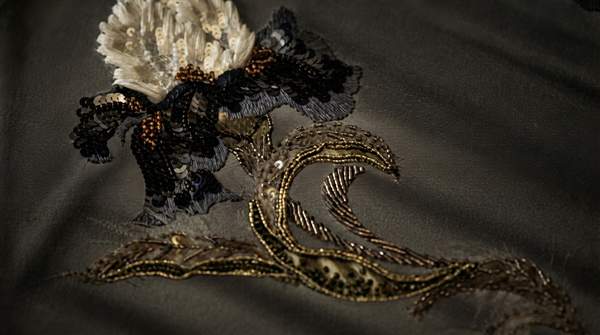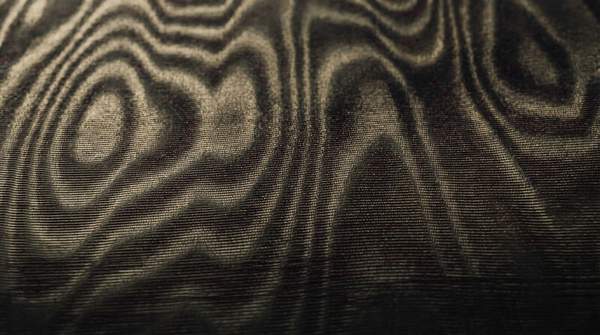
At first glance, moiré and devoré might seem like cousins—both are lustrous, patterned luxury textiles beloved by couturiers. But they are opposites in almost every way that matters. Moiré is a purely mechanical effect: ribbed fabric is crushed between hot, engraved rollers until its surface reflects light like rippling water. Devoré is a purely chemical one: a corrosive paste literally devours selected fibers from a blended cloth, leaving sheer patterns etched into solid fabric. One compresses; the other dissolves. Once you know that distinction, you will never confuse the two again.
The Art of Textile Finishing: Moiré and Devoré
Textile finishing is the craft of transforming woven cloth after it leaves the loom—altering its surface, sheen, or structure without changing the weave itself. Moiré and devoré represent the two great branches of that craft. Neither is a fiber in its own right; both describe something done to a material. As the fabric house Harlequin explains, moiré "isn't a fibre per se, but instead describes a structure or technique applied to a material." Devoré, whose name derives from the French verb dévorer—literally "to devour"—is likewise a technique, applied most famously to velvet.
The two effects also arrive at luxury from opposite directions. Moiré descends from royal and papal regalia; devoré, as we will see, has far more utilitarian roots in industrial fiber reclamation. Yet both ended up on the couture runway, prized for exactly the quality that makes them difficult to produce: their effects cannot be achieved by printing or ordinary dyeing. Light and structure do the work instead.
Moiré: The 'Watered' Silk Effect
The word moiré comes from the French for "watered," and the name is the description. The fabric's surface shows rippling, wood-grain-like bands—often described as resembling the rippling waters of a lake—that shift and shimmer as the garment moves through light. Crucially, nothing is printed. The pattern is an optical consequence of how the fabric's surface reflects light unevenly.
The process is called calendaring. A plain-woven fabric—historically silk, later linen or viscose—is first moistened, then run through specially patterned rollers under high temperature and pressure. Harlequin's account notes that certain fibers are altered while others are left alone, flattening the fabric's ribs in an irregular pattern. The result is a surface that contrasts gloss against matte, "catching the light with a fluid, glistening quality."
That ribbed structure is essential. Moiré traditionally works on ribbed silks like faille, grosgrain, and taffeta, because the pressure must have something to flatten and displace. A smooth cloth has nothing to interrupt.
The lineage is old. One historical account traces the effect to Tang Dynasty China (618–907 CE), where weavers found that layering two slightly different patterns produced a remarkable optical effect; the technique reemerged in Renaissance Europe, where wealthy merchants and aristocrats sought it out, with production centers in Italy, France, and England. By the seventeenth century, according to Harlequin, it had become "a formal, regal, and papal fabric." Its association with stiff formality faded in the mid-twentieth century, when couture houses such as Dior and Givenchy began debuting moiré evening dresses.