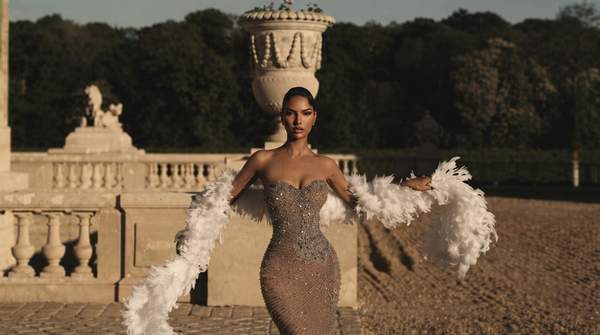
Plumasserie is the craft of applying prepared feathers onto a support—garments, accessories, or decorative objects—most often as collage, but also as embroidery. That plain definition, offered by featherworker Lina Soussi in an interview with Côté Maison, conceals the technique behind some of haute couture's most dramatic silhouettes: feathers cut, layered, curled, and sculpted until a garment stops behaving like fabric and starts behaving like architecture. Understanding the craft means understanding which technique produces which effect—collage for pattern, layering for depth, shaping for sculptural volume, and curling for motion.
The Art of Plumasserie in Haute Couture
Plumasserie sits among the specialized métiers d'art that haute couture houses depend on to realize designs that ordinary sewing cannot achieve. In the Côté Maison profile, written by Yona Baron, Soussi describes a craft in which feathers are worked and adapted to a support, most frequently in the form of collage. The piece also notes the historical connection between Chanel and the Lemarié atelier, long associated with feather and camellia work for the house—the kind of relationship through which couture's feather techniques are transmitted and refined.
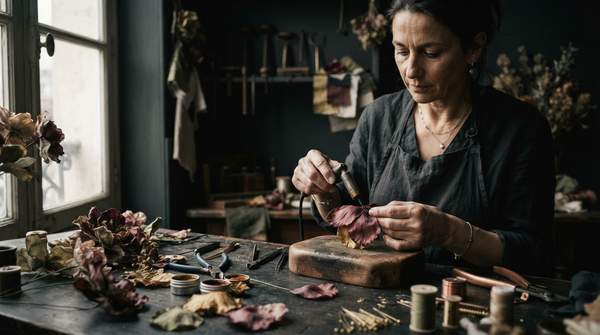
The craft's raw material is anything but uniform. Soussi emphasizes that there are many kinds of feathers, each used differently and adapted to its support. This variability is precisely what makes plumasserie a technical discipline rather than simple decoration: the artisan must judge how a given feather's structure—its barb density, flexibility, and natural curve—will behave when cut, curled, layered, or inlaid. A couture garment's final character depends on those choices made feather by feather.
Core Techniques for Feather Transformation
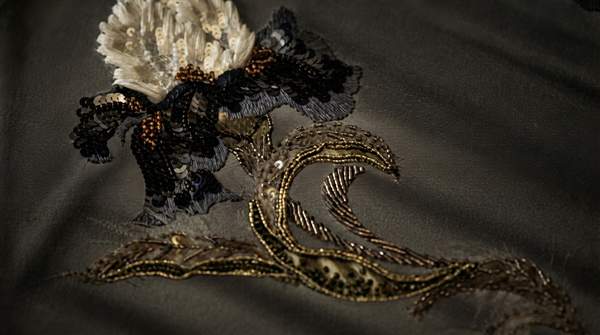
The evidence describes several distinct approaches to transforming feathers into finished couture work. Collage, the most common according to Soussi, involves cutting and arranging feathers, then fixing them onto a base material; the result tends toward flat or low-relief patterns and textures that read almost like a fabric designed from scratch. Embroidery, the other method she names, integrates feathers among stitched elements, allowing them to combine with beads and threads in a single ornamental surface.
Layering takes a different route to visual richness: feathers are overlapped so that each one partially covers the next, building volume and graduated effects that give a garment its lushness and depth. Shaping and sculpting manipulate feathers into three-dimensional forms, the technique behind the architectural silhouettes that avant-garde designers pursue. Writing on ostrich feather trends, the Fancy Feather blog credits Alexander McQueen and Iris van Herpen with using feathers shaped into abstract forms to construct dramatic silhouettes—the clearest couture expression of the sculptural approach. Finally, curling—known in the trade as frison—crimps the feather's barbs so the finished surface catches movement and lightness.