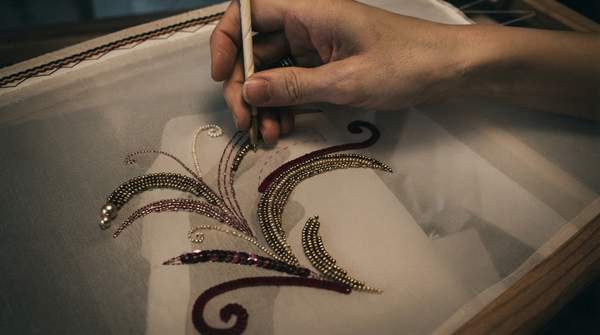
What actually distinguishes one piece of couture embroidery from another? The answer lies less in the design than in the mechanics: which tool touched the fabric, from which side, and at what speed. Three techniques dominate the conversation—Lunéville, worked with a hook from the back of the fabric; Goldwork, which lays metal threads on the surface with a needle; and 'Al Aire', which uses an antique sewing machine yet still counts as hand embroidery. Each produces a recognizably different aesthetic, and each can be identified from a handful of visual and procedural cues.
Understanding Haute Couture Embroidery
Haute couture embroidery is a specialized discipline in which decoration is applied to luxury garments with extraordinary precision—and often in an unexpected order. As the embroidery house Fra-Del, in a journal article credited to Franck Delorme, explains, a couture dress is never embroidered as a dress: it is embroidered flat, in pieces, before it exists as a garment. That single detail governs the entire craft, from sample to assembly.
The same source describes four families of techniques that make up most couture collections: the Lunéville hook, beading and sequins, gold thread and purl, and needle embroidery. Within this landscape, three named techniques stand out for how differently they solve the same problem—how to get decoration onto delicate fabric beautifully, and fast enough for a collection's calendar.
Lunéville Embroidery: The Hook Technique
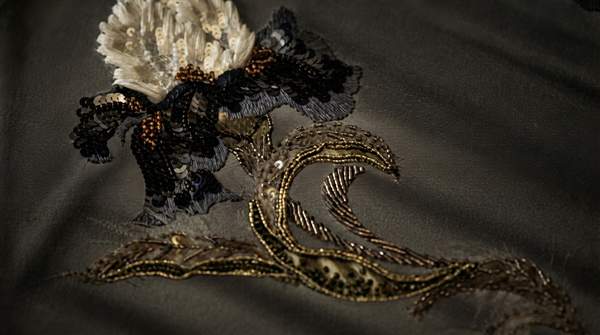
Lunéville is a French haute couture technique that uses a special hook to attach beads, sequins and decorative materials onto lightweight fabrics, creating the refined, luxurious details seen across high-fashion garments. Its defining quirk is that the embroiderer works blind, from the back: the fabric is stretched taut on a frame, and the hook punches through to form a continuous chain stitch on the reverse while pre-strung beads and sequins are pulled into place from above.
The technique has deep roots. Writing for Textile Tours of Paris, Rebecca Devaney traces it to 1865, when Louis Ferry Bonnechaux, the mayor of Lunéville in Lorraine, invented a method that would exponentially increase the speed of tambour embroidery and, in her phrase, "literally turn the craft upside-down." Fra-Del notes that the Lunéville hook is used at the houses Lesage, Montex and Hurel, applying pre-strung beads and sequins much faster than a needle could.
Goldwork: The Art of Metal Threads
Goldwork is embroidery with metal—gold thread and purl, a tradition Fra-Del says was inherited from ornamental embroidery and reserved for ceremonial pieces. Unlike Lunéville, it is worked from the front of the fabric, where the embroiderer can see and place each precious element directly.
The Victoria and Albert Museum's illustrated guide to embroidery styles situates Goldwork within the freestyle category, where nearly any design can be interpreted, from naturalistic scenes to highly decorative patterns. A signature method is couching: threads are laid onto the surface fabric and secured in place with a second thread. Because the metal thread itself never passes through the fabric—only the fine securing thread does—Goldwork achieves its precious, luminous effects while sparing the delicate metal from abrasion.
'Al Aire': Machine-Assisted Precision
The most counterintuitive of the three is 'Al Aire'. According to the Dutch Couture Academy, although it is considered hand embroidery, the technique uses an antique sewing machine. It is, the academy stresses, a completely different technique from what is known as 'Broderie d'Art', with its own character and different applications.
The trade-off is speed against mastery. The academy reports that compared with Broderie d'Art, 'Al Aire' achieves a spectacular result in a shorter time—at least, it adds wryly, after you have mastered the technique. And while it may look like one single technique, its application offers a huge number of possibilities. The paradox is the point: the machine is guided entirely by the embroiderer's hands, which is why the couture world refuses to call it anything but hand work.
Comparative Overview of Haute Couture Embroidery Techniques
Set side by side, the three techniques resolve into a clear framework. The contrast runs along three axes: the tool (hook, needle or machine), the working side of the fabric (reverse or front), and the resulting surface (beaded chain stitch, metallic luminosity, or machine-guided precision).
| Technique | Primary Tool | Working Method | Key Advantage | Aesthetic Result |
|---|---|---|---|---|
| Lunéville | Special hook, worked from the back of the fabric | Fabric stretched on a frame; continuous chain stitch formed from the reverse, applying pre-strung beads and sequins | Applies beads and sequins much faster than a needle; speed and mastery come with practice | Refined, luxurious beaded detail on lightweight fabrics |
| Goldwork | Needle, with gold thread and purl | Worked from the front; threads laid onto the surface and secured with a second thread (couching) | Freestyle flexibility—nearly any design can be interpreted | Precious, luminous metallic effects for ceremonial pieces |
| 'Al Aire' | Antique sewing machine, hand-guided | Machine-driven stitching, distinct from Broderie d'Art | Spectacular results in a shorter time, once mastered | Machine-precision effects with hand-embroidery status |
Read the table as a diagnostic tool rather than a list of facts. A garment glittering with evenly applied beads on sheer silk points to Lunéville; a raised, light-catching metallic surface points to Goldwork; a densely stitched, machine-even pattern that still carries the couture label points to 'Al Aire'.
Identifying Haute Couture Embroidery Styles
To identify a specific haute couture embroidery technique, observe the primary tool used (hook, needle, or machine), the working side of the fabric (front or reverse), and the resulting aesthetic effect (beaded chain stitch, metallic luminosity, or complex machine precision). These three cues are sufficient to sort almost any couture-embroidered piece into its family.
The measurable test is simple: the reader will be able to correctly categorize examples of haute couture embroidery into Lunéville, Goldwork, or 'Al Aire' based on visual cues and described methods. Look closely at the next embellished gown you encounter—run a finger over the surface, note whether the beads sit in a chain-stitch rhythm, whether metal thread catches the light in couched lines, or whether the stitching bears machine evenness—and the technique will announce itself.
Sources
- Haute couture embroidery: houses and techniques — Fra-Del
- From an Empress to a Marquis: The Origins of Haute Couture Embroidery — Textile Tours of Paris
- Embroidery styles: an illustrated guide — Victoria and Albert Museum
- Embroidery Technique ‘Al Aire’ — Dutchcoutureacademy