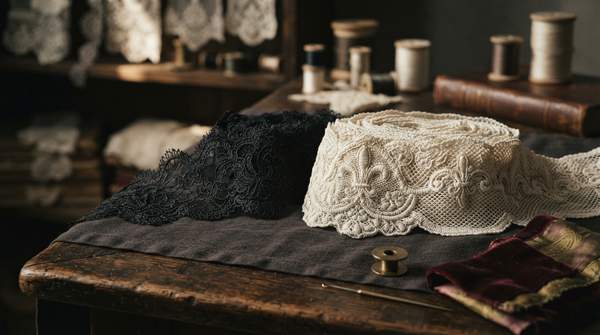
Chantilly and Alençon lace are often named in the same breath, yet they are built by opposite hands. Chantilly is a bobbin lace, woven from multiple silk threads around pins; Alençon is a needlepoint lace, stitched by hand with a single fine thread. That single technical difference explains nearly everything else: the airy, flowing character that makes Chantilly a bridal favorite, the sculptural definition that gives Alençon its formal authority, and the distinct roles each plays in couture and formalwear.
Chantilly Lace: Delicate Flow and Romantic Appeal
Chantilly lace first appeared in the town of Chantilly around 1750, and its defining feature from the start was the bobbin technique, according to the fabric house Inter Tex's guide to the lace. Its earliest form was black silk, a color that symbolized aristocratic elegance. Production nearly vanished during the French Revolution, when lace makers were persecuted, before Empress Eugénie, wife of Napoleon III, made it fashionable again in the nineteenth century.
The lace's construction accounts for its signature look. As textile historian Pat Earnshaw details in the Fashion History Timeline's entry on Chantilly, the earlier versions were made of flax, while all the later lace was of a dull grenadine silk stiffened with gum arabic. The ground, or toile, was usually of halfstitch and continuous with the fond simple, or occasionally a Point de Paris réseau; the gimp consisted of several strands of flat untwisted silk. That hexagonal halfstitched ground is visible in surviving examples and gives Chantilly its light, net-like openness.
Modern production shifted to Leavers machines in the twentieth century, Inter Tex notes, which lowered prices without sacrificing quality; today genuine Leavers Chantilly is produced mainly in Calais and is considered premium. A visual demonstration shared by Dimitra Designs on Instagram shows what this means in practice: the lace's delicate, floating quality and its scalloped edges, drifting over a gown rather than sitting stiffly upon it. Wedding dress designer Claire Pettibone describes the appeal in terms of its "romantic, timeless quality."
Alençon Lace: Structured Elegance and Defined Motifs
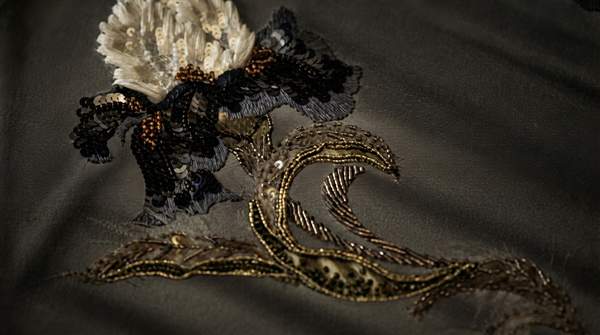
Alençon takes the opposite path to beauty. UNESCO, which inscribed the craftsmanship of Alençon needle lace-making on its Intangible Cultural Heritage lists, describes a piece made up of design elements held together by a finely stitched net. The creation process involves several distinct stages: first, the design is drawn and pricked onto parchment. This is followed by forming the outline and the background netting. Subsequent steps include the stitching of patterns, shading with filling stitches, adding decorative elements, and embroidering to achieve relief. Finally, the lace is removed from the parchment with a razor blade, trimmed, and the filling stitches are polished with a lobster claw.
The Google Arts & Culture project on Alençon lace, produced with the Mobilier National and the Manufacture des Gobelins, adds a crucial constraint: unlike other French lace techniques, the Alençon stitch can only be done by hand. It involves assembling an almost invisible combination of very small elements in ten successive steps, and every lacemaker learns all of these steps through oral transmission and practical teaching. The lace is worked in a very fine linen thread, which allows the sharp outlines and shaded fillings that define its motifs.
That hand-stitched, relief-worked character is what separates Alençon from its bobbin-made cousin: where Chantilly floats, Alençon holds its shape.
Chantilly vs. Alençon Lace: A Quick Reference Guide
The table below juxtaposes the two laces across the attributes that matter most for identification and selection. Read down each column and the contrast is immediate: two French traditions arriving at elegance by entirely different means.
| Feature | Chantilly Lace | Alençon Lace |
|---|---|---|
| Construction method | Bobbin lace technique, worked with multiple threads around pins | Needlepoint lace, made by hand with a needle; ten successive steps |
| Primary material | Early versions of flax; later lace of dull grenadine silk stiffened with gum arabic | Very fine linen thread |
| Ground / net style | Hexagonal halfstitched toile, continuous with the fond simple, or occasionally a Point de Paris réseau | Finely stitched net holding the design elements together, worked on parchment |
| Pattern character | Light, open ground with flat untwisted silk gimp outlining motifs | Outlined motifs shaded with filling stitches and embroidered in relief |
| Historical context | Emerged in Chantilly around 1750 in black silk; revived under Empress Eugénie in the 19th century | Recognized by UNESCO as intangible cultural heritage; transmitted orally through lacemaker training |
One point of terminology: the two laces are not interchangeable labels for "fine French lace." The bobbin method produces Chantilly's continuous, supple net; the needlepoint method produces Alençon's defined, dimensional motifs. If you can see crisp raised outlines and shaded fillings, you are looking at needlepoint work in the Alençon manner; if you see a hexagonal net ground with outlined motifs floating across it, that is bobbin-made Chantilly.
How the Differences Play Out in Couture and Bridalwear
These construction differences translate directly into design choices. Writing for YiTuo Lace, Alina notes that Calais and Lyon remain centers for ultra-premium laces, and that French Chantilly and Alençon command the highest prices and appear in top-tier couture. Both, in other words, belong on the couture stage—but they serve different roles on it.
Chantilly's soft drape and open ground suit romantic, flowing elements: skirts, overlays, and veils where the fabric needs to move with the wearer. Alençon's structured motifs and relief stitching suit classic, formal components where definition matters—bodices, sleeves, and appliquéd borders that hold their shape against the body. Retailer Elizabeth Johns suggests choosing between the laces on exactly these grounds, and many designers combine them within a single gown for varied effect.
Choosing the Right Lace for Your Design
The decision, then, is straightforward: select Chantilly lace for romantic, flowing elements like skirts and overlays, and Alençon lace for structured, classic components such as bodices and sleeves, combining them when a design calls for both movement and definition. The measurable indicator is the lace's visual and tactile contribution to the garment—its drape, its dimension, and how it shapes the overall silhouette. Run a swatch of each across your hand: the one that falls in soft folds is your Chantilly; the one that holds its motifs crisp and raised is your Alençon. Match that behavior to the garment section it must dress, and the right lace will announce itself.
Sources
- Chantilly Lace 2026: Complete Guide — Types, Care, Buy — Inter Tex
- chantilly lace — Fashionhistory
- Craftsmanship of Alençon needle lace-making - UNESCO Intangible Cultural Heritage — ICH
- Alençon Lace, a UNESCO Immaterial Cultural Heritage Project - Google Arts & Culture
- Wedding Dress Lace: Types, Trends & How to Choose the Best — YiTuo Lace